DP5 Network is the latest version of Ziath’s market leading 2D rack decoding web browser software designed to unchain scientists from their lab bench.
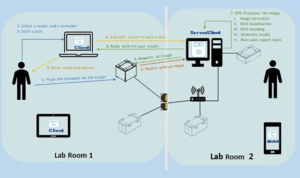
Using high-speed, web-based communications protocols – DP5 Network can be run from a laptop, desktop, phone, tablet or any other network connected device. This powerful new software enables full control of multiple tube barcode scanners on the same LAN to be operated from one or more devices connected to that LAN.
Using DP5 Network you can plug all your tube rack readers and scanners into the LAN directly and run them from a PC in your office or somewhere else in the building. This flexibility enables you to have your reader / scanner conveniently near the freezers or compound stores and the results on your desktop or phone.
DP5 Network is fast and secure – it allows you to export tube positions and barcodes in more formats than anyone else – JSON, XLS, CSV, Text, PDF, PNG and Python and then send the data in an email to a colleague or your desktop PC.
Upgrade to DP5
Ziath
Founded in 2005, Ziath specialises in development of innovative instrumentation control and information management products using 2D Data Matrix bar-coded tubes to simplify automation processes in life science organisations, from academia, to the biotech and pharma industries.
Contact Ziath on: +44-1223-855021 / +1-858-880-6920 / info@ziath.com.




Journees De L’Innovation en Biologie – 64th edition – 1-2 December 2021
, /in Events /by panglobalRegistration is open for the Journees De L’Innovation en Biologie – 64th edition
The event takes place in Paris, France from 1-2 December 2021.
JIB 64th edition
Dec 1-2, 2021
Paris, France
www.jib-innovation.com
Network-enabled remote sample management for your lab
, /in Product News /by panglobalDP5 Network is the latest version of Ziath’s market leading 2D rack decoding web browser software designed to unchain scientists from their lab bench.
Using high-speed, web-based communications protocols – DP5 Network can be run from a laptop, desktop, phone, tablet or any other network connected device. This powerful new software enables full control of multiple tube barcode scanners on the same LAN to be operated from one or more devices connected to that LAN.
Using DP5 Network you can plug all your tube rack readers and scanners into the LAN directly and run them from a PC in your office or somewhere else in the building. This flexibility enables you to have your reader / scanner conveniently near the freezers or compound stores and the results on your desktop or phone.
DP5 Network is fast and secure – it allows you to export tube positions and barcodes in more formats than anyone else – JSON, XLS, CSV, Text, PDF, PNG and Python and then send the data in an email to a colleague or your desktop PC.
Upgrade to DP5
Ziath
Founded in 2005, Ziath specialises in development of innovative instrumentation control and information management products using 2D Data Matrix bar-coded tubes to simplify automation processes in life science organisations, from academia, to the biotech and pharma industries.
Contact Ziath on: +44-1223-855021 / +1-858-880-6920 / info@ziath.com.
Basic Metabolic Panel. STAT.
, /in Advertenties /by panglobal8-11 November 2021 IHF Barcelona 44th World Hospital Congress
, /in Advertenties /by 3wmediaTissue dissection: the missing link in modern molecular pathology
, /in Featured Articles /by panglobalHistopathology has benefitted hugely from the digitization of whole slide imaging, allowing remote discussions (telepathology), image archiving which facilitates storage and retrieval, comparison of areas on different slides, and direct slide annotation. However, until recently, the selection of tissue from the slide for further downstream molecular analysis has still been a time-consuming, manual process. This […]
Bridging the omics gap: From clinical research to pathology
, /in Featured Articles /by panglobalMatrix-assisted laser desorption/ionization (MALDI) imaging is a technique that is on the cusp of revolutionizing histopathology. This article discusses the benefits of MALDI imaging and how it is beginning to be used in oncology, with particular relevance to the challenging area of lipid analysis.
IL-6 and identification of patients most at risk of severe COVID complications
, /in Featured Articles /by panglobalDuring the course of the last 18 months, we have learned a lot about COVID-19, which was a new disease. It became apparent early on that one outcome of severe COVID-19 was acute respiratory distress syndrome (ARDS), with patients usually requiring mechanical ventilation. CLI caught up with Dr Anagh Vora (Senior Vice President and Chief […]
Anti-Müllerian hormone as a biochemical marker of gonadal development and fertility status
, /in Featured Articles /by panglobalAnti-Müllerian hormone (AMH) plays a critical role in sex differentiation in fetal development and goes on to be important in the regulation of folliculogenesis in women. This article discusses the role of AMH in reproductive physiology and the many different situations where assessment of AMH levels is useful, as well as touching on methods of […]
The only glucose meter cleared by the U.S. FDA for use with critically ill patients
, /in Advertenties /by Nova Biomedical Corp.Dip&Spin® Urinalysis Dipstick & Microscopics Control
, /in Advertenties /by panglobal