3Brain AG has introduced a new technology based on a unique combination of microchips and AI that promises to change the way drug candidates are selected at the preclinical level to enter into clinical trials – and to maximize their chances of success.
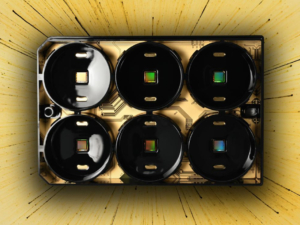
Using CorePlate™ technology, preclinical cell assays are performed in multiwell plates that integrate a microchip in each well to collect rich information from cells, pre-process cell data and streamline it to the paired software. As a result, much more and better data can be extracted, which can be referred to as cell big data. This is fed to an AI with the aim of simplifying interpretation and enabling researchers to discover more information about drugs being tested.
Preclinical studies are vital for early identification of any safety and efficacy issues, and for increasing the chance of success of those drugs entering clinical trials. However, common estimates show that there is still a lot to improve in this area as 90% of the drugs that enter into human trials fail. Among the factors responsible for this high failure rate are the limitations of conducting preclinical tests on animal models. The vast majority of drugs that pass tests on animals do not later work on humans because disease mechanisms vary significantly between species.
New biotechnologies like human stem cells offer more successful alternatives to animal models. These may be in the form of cell culture assays or more sophisticated spheroid and organoid assays that can be used as testbeds for drugs. Human cell-based assays hold the promise to revolutionize drug development, improving the success rate and pushing animal tests towards extinction.
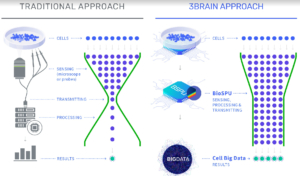
Whatever cell-based assay one wants to investigate, traditional approaches extract cell information via optical systems or a few sensors embedded in plastic substrates. Typically, these substrates are multiwell plates with 24, 96 or even more wells, where each well houses the cell samples to be measured. From these wells, the acquired information travels on limited bandwidth across long distances (compared to the cell size) before reaching a CPU where it gets processed. Long distances and bandwidth issues affect the quality and quantity of information and, consequently, prevent an accurate inspection of cell networks. The CorePlate technology devised by 3Brain disrupts this paradigm by bringing the processing unit in contact with the cells.
“We want to radically change the way preclinical drug screening is performed, offering pharmaceutical companies the opportunity to manage their pipelines more efficiently,” says Mauro Gandolfo, CEO and co-founder of 3Brain AG. “Basically, we take traditional plastic multiwell plates and we turn them into intelligent devices with multi-core processing power, which can be programmed according to research needs. Integrated intelligence is a remarkable distinction from other instruments in the preclinical space. Importantly, despite the large amounts of data CorePlate devices can process, the user can still easily generate results thanks to the AI-driven interpretation of data. With the CorePlate technology, pharmaceutical companies can save time and money by better filtering and prioritizing drug candidates. Our ultimate goal is to provide our users with tools that help them more readily identify new cures for diseases.”




Avacta announces EU registration of its AffiDX SARS-CoV-2 Antigen Lateral Flow Test
, /in Product News /by panglobalAvacta Group, the developer of diagnostics and innovative cancer therapies based on its proprietary Affimer® and pre|CISION™ platforms, has received notice of registration of its AffiDX® SARS-CoV-2 antigen lateral flow test in the EU allowing the company to market the product in the EU for professional use.
Lateral flow antigen tests are intended to provide a cost effective and rapid means of identifying individuals with a high viral load that means they are more likely to infect others. The clinical data for Avacta’s AffiDX SARS-CoV-2 antigen lateral flow test reported 20 April 2021, demonstrated 100% sensitivity for identifying infectious individuals with viral loads measured by PCR of Ct<27.
Dr Alastair Smith, Chief Executive Officer of Avacta Group, commented: “The EU is an important market for us, and the product registration is a key commercialisation milestone.
“The results of the recent clinical evaluation of the test at a clinical site in Europe demonstrate the test has excellent sensitivity across a range of viral loads, which would be considered infectious. This excellent performance and ease of nasal sampling, coupled with the fact that the AffiDX test is has been developed in the UK, is based on UK technology and is manufactured in the UK, are huge selling points for customers in Europe.”
3Brain’s CorePlate technology combines microchips and AI in a revolutionary new approach to drug discovery
Laboratory, /in Product News /by panglobal3Brain AG has introduced a new technology based on a unique combination of microchips and AI that promises to change the way drug candidates are selected at the preclinical level to enter into clinical trials – and to maximize their chances of success.
Using CorePlate™ technology, preclinical cell assays are performed in multiwell plates that integrate a microchip in each well to collect rich information from cells, pre-process cell data and streamline it to the paired software. As a result, much more and better data can be extracted, which can be referred to as cell big data. This is fed to an AI with the aim of simplifying interpretation and enabling researchers to discover more information about drugs being tested.
Preclinical studies are vital for early identification of any safety and efficacy issues, and for increasing the chance of success of those drugs entering clinical trials. However, common estimates show that there is still a lot to improve in this area as 90% of the drugs that enter into human trials fail. Among the factors responsible for this high failure rate are the limitations of conducting preclinical tests on animal models. The vast majority of drugs that pass tests on animals do not later work on humans because disease mechanisms vary significantly between species.
New biotechnologies like human stem cells offer more successful alternatives to animal models. These may be in the form of cell culture assays or more sophisticated spheroid and organoid assays that can be used as testbeds for drugs. Human cell-based assays hold the promise to revolutionize drug development, improving the success rate and pushing animal tests towards extinction.
Whatever cell-based assay one wants to investigate, traditional approaches extract cell information via optical systems or a few sensors embedded in plastic substrates. Typically, these substrates are multiwell plates with 24, 96 or even more wells, where each well houses the cell samples to be measured. From these wells, the acquired information travels on limited bandwidth across long distances (compared to the cell size) before reaching a CPU where it gets processed. Long distances and bandwidth issues affect the quality and quantity of information and, consequently, prevent an accurate inspection of cell networks. The CorePlate technology devised by 3Brain disrupts this paradigm by bringing the processing unit in contact with the cells.
“We want to radically change the way preclinical drug screening is performed, offering pharmaceutical companies the opportunity to manage their pipelines more efficiently,” says Mauro Gandolfo, CEO and co-founder of 3Brain AG. “Basically, we take traditional plastic multiwell plates and we turn them into intelligent devices with multi-core processing power, which can be programmed according to research needs. Integrated intelligence is a remarkable distinction from other instruments in the preclinical space. Importantly, despite the large amounts of data CorePlate devices can process, the user can still easily generate results thanks to the AI-driven interpretation of data. With the CorePlate technology, pharmaceutical companies can save time and money by better filtering and prioritizing drug candidates. Our ultimate goal is to provide our users with tools that help them more readily identify new cures for diseases.”
Insight into precision medicine for genetically diverse populations
, /in Featured Articles /by 3wmediaThe development of molecular biology has driven a revolution in our understanding of disease at the molecular level, greatly improving diagnosis, prognosis and therapeutic decision-making. The study of both data and physical specimens deposited in biobanks is crucial for this. However, the vast majority of biobanks are based in Europe and North America, and the […]
Biomarkers for improved management of prostate cancer
, /in Featured Articles /by 3wmediaProstate cancer is an extremely complex and heterogenous disease. A significant problem in the clinical management of PCa is being able to accurately stratify patients based on their risk for aggressive disease. Traditional biomarkers and clinical methods for personalized treatment are insufficient. Appropriate stratification of patients based on their risk for aggressive disease is required […]
Why we should be measuring ionized magnesium
, /in Featured Articles /by 3wmediaThe majority of magnesium in the body is located in bone and muscle; however, the small extracellular proportion of ionized magnesium plays an important role in a number of physiologic processes. Generally, when assessing magnesium concentration, total magnesium is measured. This article discusses the importance of ionized magnesium and why we should be directly measuring […]
Tracing footsteps: exploring friendly viruses to diagnose Lyme disease
, /in Featured Articles /by 3wmediaDespite the progress that has been achieved in Lyme disease (LD) diagnostic development in recent years, lack of early and effective diagnosis of LD remains a major cause of misdiagnosis and long-term patient suffering. We invented a novel way of detecting LD-causing bacteria. The new technology could potentially transform LD diagnostics through the innovative use […]
Role of external quality assessment in clinical laboratory quality assurance
, /in Featured Articles /by 3wmediaWhen specimens are analysed in the clinical laboratory, it is crucial that the results that are reported back to the clinician are accurate. If not, at best, results would not be comparable from the same laboratory on different days or between different laboratories at all. At worst, disease could remain undiagnosed or over-diagnosed with the […]
Takara Bio Europe AB and PanCryos announce licensing agreement to enable development of cell-based therapy for diabetes
, /in E-News /by panglobalTakara Bio Europe AB (TBEAB) and PanCryos have reached a licensing agreement surrounding TBEAB’s clinical-grade human embryonic stem (hES) cell lines. PanCryos has established a simplified and effective method to generate stem cell-derived, glucoseresponsive beta cells and is one of several customers in TBEAB’s new out-licensing programme.
SignalChem enters clinical trial collaboration with Merck to evaluate effect of SLC-391 in combination with pembrolizumab in advanced NSLC
, /in E-News /by panglobalSignalChem Lifesciences, a clinical-stage company developing novel targeted therapies for oncology, is collaborating with Merck (MSD) through a subsidiary, to evaluate the combination of SLC-391, a selective AXL inhibitor developed by SignalChem, with KEYTRUDA (pembrolizumab), Merck’s anti-PD-1 therapy, in patients with advanced non-small cell lung cancer (NSCLC).
Phico Therapeutics awarded up to $18.2 million to advance SASPject antibacterial therapy through Phase 1 clinical trials
, /in E-News /by panglobalPhico Therapeutics, a biotechnology company developing engineered phage technology as the basis of a new generation of antibiotics to overcome antibacterial resistance, has been awarded a grant of up to US$18.2 million from Combating Antibiotic Resistant Bacteria Biopharmaceutical Accelerator (CARB-X), a global non-profit partnership dedicated to accelerating antibacterial research.