
Breakthrough synthesis of rare plant alkaloids opens new avenues in anticancer drug discovery
Researchers at Chiba University in Japan have achieved the first total synthesis of bousigonine B and a new synthesis of bisleuconothine A, two highly complex monoterpenoid indole alkaloids (MIAs) with demonstrated anticancer activity. Using an innovative organocatalytic cascade strategy and bioinspired coupling reactions, the team has established a versatile platform that may accelerate the development of next-generation pharmaceutical agents targeting previously inaccessible biological pathways.
The therapeutic promise of oligomeric MIAs
Monoterpenoid indole alkaloids represent one of the most structurally diverse classes of plant-derived natural products, and their oligomeric forms have attracted particular interest in drug discovery research. Unlike conventional small-molecule drugs, oligomeric MIAs possess large, three-dimensional architectures capable of disrupting protein-protein interactions within cells – a class of molecular target historically resistant to pharmacological intervention. Bisleuconothine A, first isolated from plant bark in 2010, has demonstrated potent activity against both breast cancer and lung cancer cell lines, making it a compelling lead compound for oncology drug development.
Despite this therapeutic potential, the extraordinary structural complexity of oligomeric MIAs has severely constrained laboratory synthesis. Their frameworks incorporate multiple fused ring systems and several precisely configured stereocentres, requiring atoms to be assembled in exact three-dimensional orientations to preserve biological activity. This synthetic barrier has until now significantly limited the scope of preclinical research on these compounds.
A novel organocatalytic cascade approach
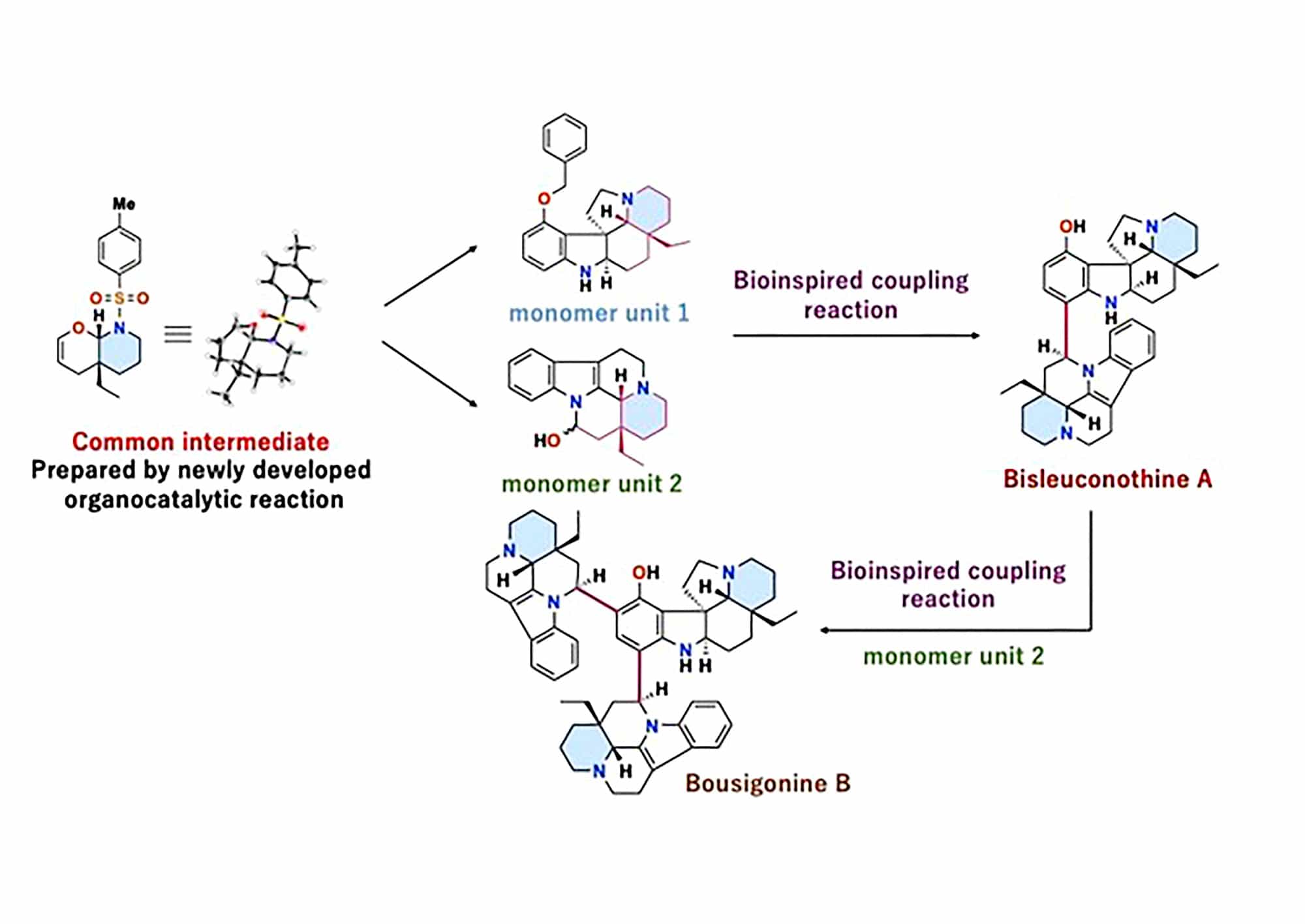
To overcome these obstacles, Professor Hayato Ishikawa and colleagues from the Graduate School of Pharmaceutical Sciences at Chiba University developed a new organocatalytic reaction driven by small organic molecules rather than metal-based catalysts. The reaction constructs a 3-ethylpiperidine scaffold, a structural motif common to many indole alkaloids and essential for MIA synthesis. Crucially, the strategy exploits a cascade mechanism in which multiple chemical transformations proceed sequentially within a single reaction vessel. Using only a catalytic quantity of the organic catalyst, the team produced a highly enantiomerically pure intermediate that subsequently functioned as a shared building block for divergent alkaloid assembly.
From this common intermediate, two distinct alkaloid fragments were elaborated and then joined through a bioinspired coupling reaction designed to replicate the biosynthetic logic plants may employ when naturally constructing these compounds. This approach delivered bisleuconothine A in 20 synthetic steps, with bousigonine B accessible through one additional transformation – constituting its first ever total synthesis. The work was published in Angewandte Chemie International Edition on 23 May 2026.
Implications for drug discovery
The significance of this methodology extends beyond the two target molecules. Because the organocatalytic cascade generates a versatile common intermediate convertible into multiple alkaloid families, it offers a potentially broad platform for synthesising structurally related natural products. “The present method for total chemical synthesis is expected to facilitate the development of new pharmaceutical agents. In particular, bisleuconothine A has exhibited potent anticancer activity, highlighting its potential as a lead compound for anticancer drug development,” said Prof. Ishikawa.
Future directions
The research team is now extending this synthetic framework to additional MIAs and integrating biological evaluation into the pipeline. “Current efforts are directed toward the collective total synthesis of additional MIAs based on this newly established methodology, as well as subsequent biological evaluation for drug-discovery applications,” Prof. Ishikawa added. For clinical laboratory scientists, this work signals a significant development in the supply of complex natural product standards and potential therapeutic candidates that were previously unobtainable in sufficient quantities for rigorous pharmacological study.
Journal reference:
Matsumiya, S., Mizukami, Y., Kitajima, M., et al. (2026). Enantioselective total syntheses of bisleuconothine A and bousigonine B. Angewandte Chemie International Edition. https://doi.org/10.1002/anie.6698305
Professor Hayato Ishikawa from
Chiba University, Japan