
Making Free Light Chain Testing More Accessible: A Multi-platform Approach with Kλoneus®
Quantitative serum and urine FLC testing across nephelometric and turbidimetric systems, designed to fit into established laboratory workflows.
Free light chain (FLC) measurement is an established component of laboratory investigation and monitoring in gammopathies. For clinical laboratories, however, the challenge is not only having access to FLC testing, but integrating it efficiently into the analytical environment already in place.
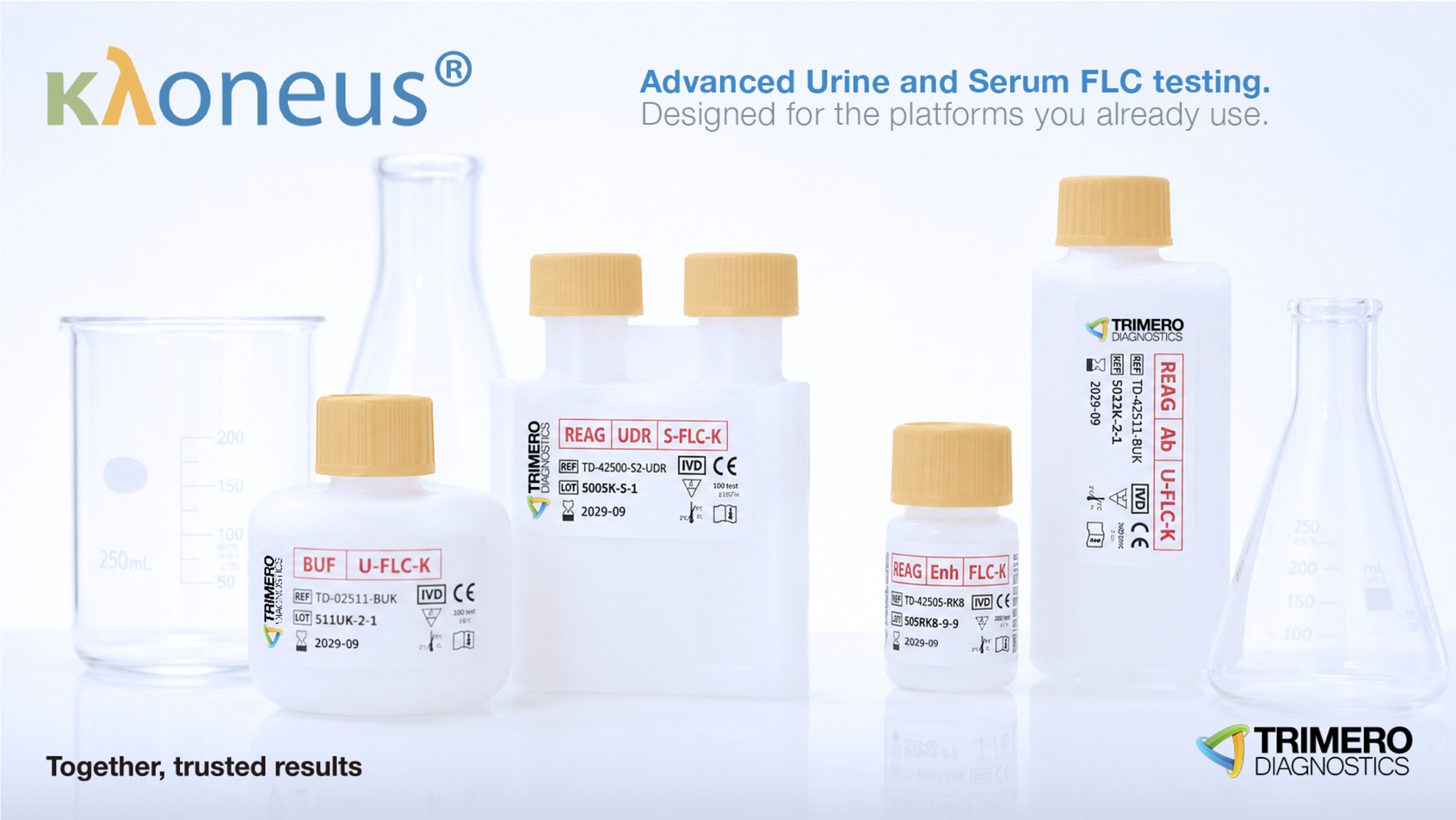
This is where Kλoneus® Free Light Chains, from Trimero Diagnostics, offers a multi-platform approach. The portfolio provides quantitative determination of free kappa and lambda light chains in serum and urine using nephelometric and turbidimetric technologies. Applications are available for a range of commonly used analytical platforms, including Siemens Healthineers BN™ and Atellica® NEPH systems, Beckman Coulter IMMAGE® 800, and clinical chemistry analysers such as Advia®, Alinity C, AU®, Atellica®, cobas® C and Mindray among others.
For laboratories, this platform flexibility can simplify the integration of specialised protein testing into established workflows. Rather than requiring a separate analytical environment, Kλoneus® provides FLC applications across both dedicated protein analysers and clinical chemistry platforms. Its particle-enhanced assay formats are designed for quantitative FLC measurement in serum and urine, supporting laboratories with different analytical configurations.
From serum testing to urinary FLC measurement
The clinical relevance of FLC measurement extends beyond serum. Quantitative urinary FLC assessment can also be relevant when investigating light-chain excretion, including suspected Bence Jones proteinuria.
Trimero describes an alternative approach based on IFCC guidance in which quantitative FLC measurement in non-concentrated urine can be used as an initial screening step, with immunofixation of concentrated urine used subsequently when further characterisation is required. This workflow illustrates the potential value of combining quantitative FLC measurement with established electrophoretic and immunofixation techniques rather than viewing them as competing approaches.
Consistency matters in quantitative protein testing
For laboratories performing quantitative measurements routinely, analytical continuity is another important consideration. Kλoneus® values are traced to the European Reference Material ERM-DA470k/IFCC, providing a reference basis intended to support consistency between reagent lots and different analyzers.
Ultimately, the value of an FLC assay depends not only on the biomarker being measured, but also on how effectively the test fits the laboratory’s analytical environment. Platform compatibility, serum and urine applications, and an approach focused on analytical consistency can all contribute to a more integrated FLC testing workflow.
With more than 30 years of experience in clinical protein diagnostics, Trimero Diagnostics specialises in protein measurement using nephelometric and turbidimetric technologies. Kλoneus® forms part of its broader portfolio of specialised protein assays designed for different laboratory platforms.
Kλoneus® brings quantitative Free Light Chain testing into the analytical environments laboratories already rely on.
For more information about Trimero Diagnostics and its product portfolio, visit Trimero Diagnostics – Products.