


Genetic interaction map of essential tuberculosis genes points towards new drug combinations
Researchers at The Rockefeller University have mapped how essential genes interact in Mycobacterium tuberculosis, identifying nearly 6,500 genetic interactions across 762 genes. Published in the journal Nature, the study assigns functional clues to previously uncharacterised genes, predicts synergistic and antagonistic drug pairings, and offers a publicly available resource that could help guide combination therapies against tuberculosis, the world’s deadliest pathogen.
A first map of essential-gene interactions
A team led by Jeremy Rock at The Rockefeller University has produced what the authors call “the first comprehensive GI map of essential genes in Mtb”, the bacterium that causes tuberculosis. The genetic interaction (GI) study links gene function directly to drug-target relationships, which bears on how combination regimens might be designed.
“Yeast geneticists have used a similar approach to transform our understanding of fundamental cell biology; ever since I started working on TB, I’ve dreamed of bringing this idea to the study of Mtb,” says Rock.
The gap it addresses is considerable. The authors state that “many of its genes remain uncharacterised, which limits the insight that can be gained into tuberculosis biology and constrains drug development.” Natalie Sayegh, a co-first author and Rock lab biomedical fellow, says: “There are a lot of genes in the Mtb genome that are just completely uncharacterised.” She adds: “We don’t know what they do.”
Dual knockdown at scale
The team built a dual-sgRNA CRISPR-interference platform that suppresses two genes at once without killing the bacterium, with unique barcodes tracking each guide pair. A positive interaction means the combination is milder than expected; a negative one, including synthetic lethality, is more severe.
After refining the method in Mycobacterium smegmatis (1,524 sgRNAs targeting 787 genes, nearly 8,500 interactions), the researchers screened Mtb with 1,483 sgRNAs targeting 762 genes, about 2.2 million guide permutations. The Mtb map reveals nearly 6,500 interactions, a 2.2% hit rate, with negative outnumbering positive. Most genes interact with fewer than 12 partners, while 26 of the 762 (3.4%) showed none. Known relationships, such as dnaJ1 with dnaJ2 and cwlM with murA, were recovered, supporting the platform’s validity.
From gene function to drug pairings
Several uncharacterised genes clustered with subunits of complex III2IV2, part of the electron transport chain. In strains lacking cytochrome bd oxidase, their knockdown reduced oxygen consumption, and in M. smegmatis deleting ms2764 abolished succinate-driven acidification in membrane vesicles, indicating loss of complex activity. The authors also ran AlphaFold3 co-folding on roughly 600,000 gene pairs, yielding 15,240 candidate protein–protein interactions. The map further identifies “pleiotropic sensitisers” (ppk, macE, dnaA, rnc, treS, sodA and pknG) with strong negative GIs across numerous targets.
The maps also predicted drug behaviour. The authors validated four synergistic compound pairs (the PptT inhibitor 8918 with thiolactomycin, thiacetazone or isoxyl, and V49 with ethambutol) and one antagonistic pair, BRD8000.3 with mCMX410, forecast by a strong positive pks13–efpA interaction. The 8918 and thiolactomycin synergy held in clinical Mtb strains representing diverse lineages, and V49, a PknA and PknB inhibitor, enhanced killing by ethambutol.
“There’s this large portion of the TB genome that has been off limits to drug discovery efforts,” says Sayegh. Michael DeJesus, co-senior author and computational biology lead, adds: “Having this systematic data informing the design of new regimens is potentially incredibly useful.”
Limitations
The authors are clear about constraints. They describe the dataset as “a first-generation GI map in mycobacteria and, as such, inevitably includes both false positives and false negatives.” They also note that “CRISPRi-mediated target depletion is not equivalent to small-molecule inhibition”, and that drug interactions depend on concentration. The maps were generated in standard laboratory strains and culture conditions.
Next, the team plans to extend the approach to nonessential genes and to conditions resembling human infection. The authors conclude that the work “defines the architecture of essential-gene networks in mycobacteria, advancing both our understanding of tuberculosis biology and the rational design of combination therapies.” The data are publicly available online. “What excites me most is that we’re really just scratching the surface,” says Rock.
Reference:
Kresse, I. J., Sayegh, N. Y., Munsamy-Govender, V., et al. (2026). Comprehensive mapping of essential-gene interactions in M. tuberculosis. Nature. https://doi.org/10.1038/s41586-026-11212-0
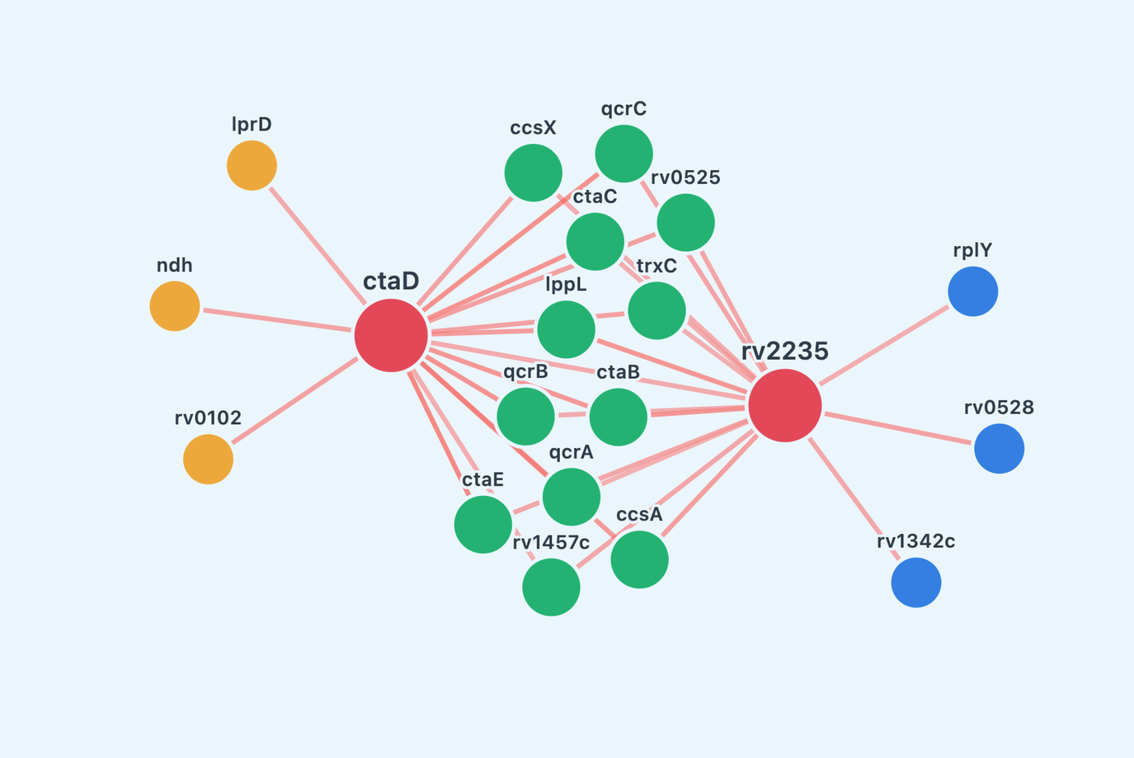
Genetic interaction networks, such as the one pictured here, allowed researchers to predict functions for previously uncharacterized genes. © Rock Lab at The Rockefeller University