


Dried blood protocol detects Zika and hepatitis C RNA without laboratory equipment
A new dried whole blood protocol allows Zika virus and hepatitis C virus RNA to be amplified and detected without extraction, purification or a centrifuge. Using a portable heater and a low-cost, palm-sized fluorescence reader, University of Illinois Urbana-Champaign researchers detected both viruses at low concentrations in whole blood, with the workflow taking around two hours from sample to result.
Researchers at the University of Illinois Urbana-Champaign have developed a protocol that detects viral RNA directly in whole blood without laboratory purification, according to a study published in Science Advances on 4 September 2026. The method dries the blood sample with heat, preserves the viral RNA within the dried matrix, amplifies it and reads the signal by fluorescence.
“Medical infrastructure is currently organized around standard-of-care testing, where samples are collected then transported to a laboratory where time-consuming processing is performed using sophisticated equipment,” said lead author Jongwon Lim, formerly a postdoctoral researcher at Illinois Grainger Engineering and now at the Broad Institute of MIT and Harvard. “We want to shift that to point-of-care testing, where the processing is performed where the sample is collected.”
Lim added: “The main paradigm has been to replicate laboratory approaches at the point of care, but this comes at the cost of reduced sensitivity. Our work reimagines the testing procedure from the ground up as something truly designed to be at the point of care.”
The authors identify sample preparation as the major bottleneck of standard-of-care workflows, accounting for up to 90% of total hands-on time.
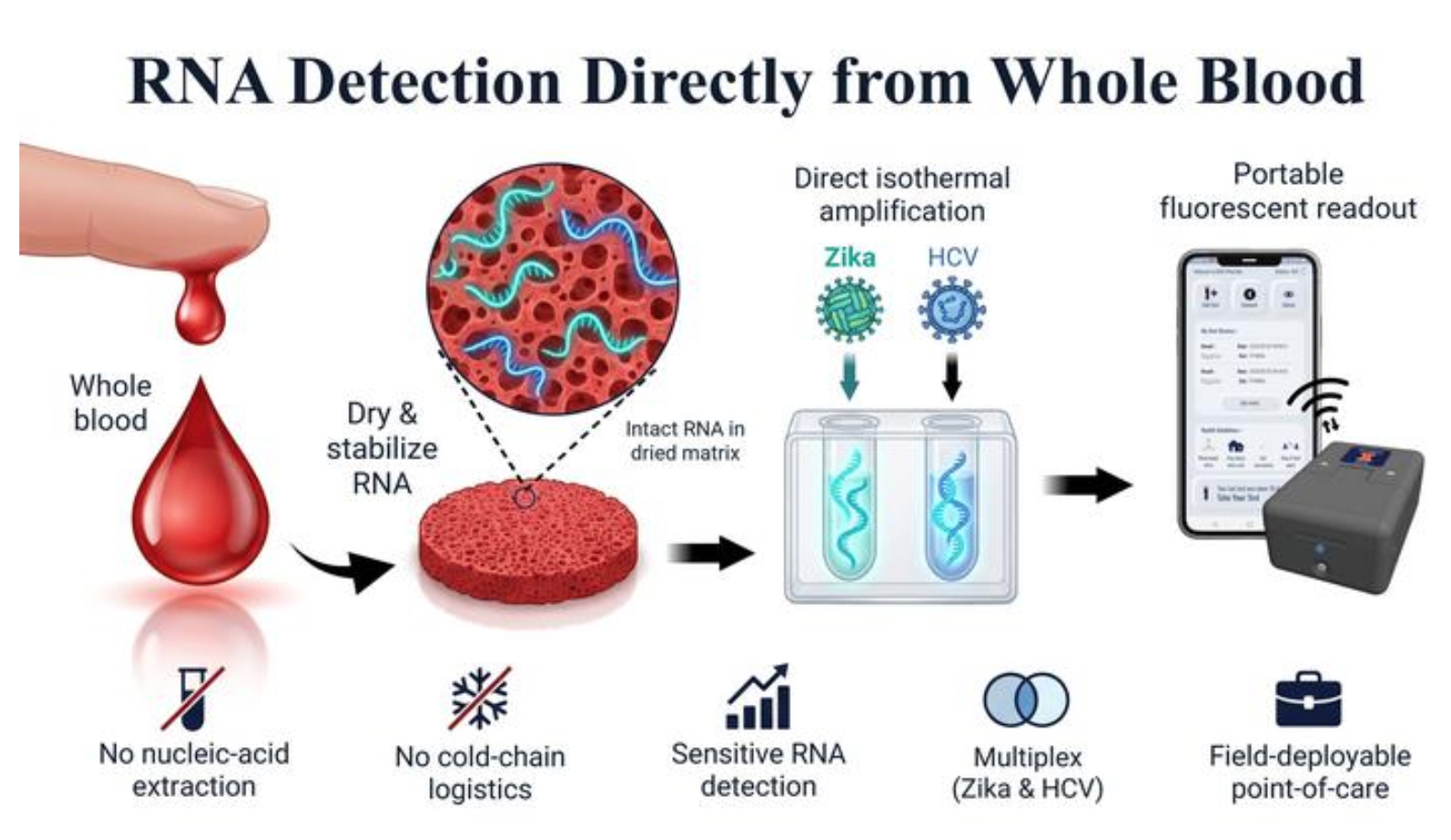
Protecting RNA in a dried matrix
The work combined the groups of Professor Rashid Bashir and Professor Brian Cunningham. It extends an earlier biphasic DNA method to RNA, which is harder because RNA is unstable in whole blood. In water, 2390 copies/µl of Zika RNA were recovered after incubation, but only 2.58 copies/µl from untreated blood, representing more than 99.8% degradation. An RNase inhibitor restored recovery to 1104 copies/µl, a more than 400-fold improvement.
The optimised workflow combines RNase inhibition, 30 minutes of drying at 37°C, thermal lysis at 95°C, a primer-limited reverse transcription step at 55°C and isothermal RT-LAMP amplification at 65°C. Drying creates a porous solid phase, while amplification proceeds in a liquid phase spatially separate from inhibitory blood components. Lim tested hundreds of reagent combinations. “We needed to come up with a way to prevent degradation at each step of the procedure,” he said.
Sensitivity and reusable RNA
“Using whole blood, the platform achieves high detection sensitivity, down to 10 copies per microliter for Zika virus and 1 international unit per microliter for hepatitis C virus (HCV),” the authors note. At 1 IU/µl, HCV amplified in two of eight replicates. When 100 µl of blood was split into 25 reactions, HCV was detected down to 10 IU in a single replicate, whereas the team’s in-house extraction followed by RT-PCR detected HCV in only one of three replicates at 500 IU input, with estimated recovery of about 0.06%.
The dried matrix also retained RNA in a reusable form. “Unlike traditional diagnostic workflows where samples are consumed after one use, our platform enables multiple rounds of RT to be performed on the same dried blood sample, each time generating cDNA for downstream amplification,” the authors wrIte. A duplex assay identified Zika virus and HCV simultaneously with no cross-talk between channels, and embedded RNA remained detectable after seven days at 4°C, −20°C and −80°C.
Portable heater and pocket-sized reader
For point-of-care use, the team lyophilised the RT-LAMP master mix and dried the primers. Primers stored for seven days at room temperature with desiccant performed comparably with those stored at −20°C. Results were read on VPodDuo, a palm-sized fluorometer developed in Cunningham’s group that costs $60 and sends data to a smartphone by Bluetooth. The integrated workflow identified inactivated Zika virus at 10,000 to 10 copies/µl and active HCV at 10,000 to 10 IU/µl, with all negative samples below threshold (P < 0.0001). The estimated cost is about $3.59 per reaction.
Caveats and next steps
Validation used commercially sourced whole blood spiked with viral material, not clinical samples. The authors also note that “further investigation is warranted to evaluate long-term room temperature storage for potential sample transport and centralized testing”.
Lim anticipates wider use. “I think this will lead to a huge leap forward in how we detect other diseases caused by RNA viruses such as Ebola and Lassa fever,” he said. The authors conclude: “we take a step closer to true POC molecular diagnostics that are simple, robust, and deployable anywhere.”
Reference:
Lim, J., Lee, H., Wester, M., et al. (2026). Amplification of RNA for identification of Zika and HCV in whole blood. Science Advances, 12, eaeb6129. https://doi.org/10.1126/sciadv.aeb6129