


Standard drug testing is regularly carried out using urine, blood or oral fluid. However, fingerprints present a good alternative, as the sample collection is non-invasive, rapid and safe. Herein, we describe the application of two different testing methods for the detection of cocaine in fingerprint samples.
by Dr Catia Costa, Dr Mahado Ismail and Dr Melanie J. Bailey
Drug abuse in the United Kingdom is on the rise and it is a cause for concern, with widespread financial and social implications [1, 2]. The ever-growing drug and alcohol culture in the UK has led to the implementation of workplace drug testing in many industries, especially those in high-risk operational environments. Consequently, there has been a surge in the demand for drug-screening suppliers to develop faster and more reliable testing. This demand is set to increase the market value of drug and alcohol testing in the UK from £167 million to £231 million by 2019 [3].
Conventionally, drug testing is carried out using biological matrices such as blood, urine and, more recently, oral fluid. These matrices and methods of analysis, although established, present a few problems relating to sample collection and transportation. The collection of blood requires medically trained personnel and sample collection is considered invasive, whereas urine carries privacy concerns. Oral fluid is an alternative matrix used for non-invasive drug testing, although sample collection can be time-consuming. All these three matrices are also biohazardous, making sample storage and transportation a potential issue. The potential use of fingerprints for drug testing has become the subject of many recent publications. Fingerprint samples present a good alternative for drug testing as collection is non-invasive and rapid, and there are no known biohazards associated with the sample. Additionally, the fingerprint pattern can be used for donor identification.
Chemical analysis of fingerprints
The chemical information embedded in a fingerprint sample has been reviewed by many, and several publications have explored the detection of substances such as cocaine [4–6], heroin [7], methadone [8], lorazepam [9], methamphetamines [10], caffeine [11] and cough medicine [12] in fingerprints after administration of the substances. These reports are predominantly based on liquid chromatography-mass spectrometry (LC-MS), which is very well established in the field of toxicology for its quantitative potential as well as its sensitivity and reliability. New advances in the field of mass spectrometry saw the rise of ambient ionization mass spectrometry techniques that allow the sample to be analysed in its native state, under ambient conditions. Examples include desorption electrospray ionization (DESI), liquid extraction surface analysis (LESA) and paper spray, which have been applied to the detection of cocaine and metabolites in fingerprint samples [4–6].
Most of these reports in the literature have looked at fingerprint samples collected after administration of the substances. However, no research has investigated the significance of the detection of these substances compared to a large background population of non-drug users. This is of particular importance as a positive test result may be the outcome of contamination by contact with contaminated surfaces or handling the parent drug rather than ingestion. This directly highlights the need for a sampling strategy that removes any contact residue while providing enough fingerprint material for the analysis.
Detection of cocaine in fingerprints
The detection of cocaine in fingerprints has been studied and reported by Ismail et al. [7]. This study looked at fingerprints collected from the background population (i.e. non-drug users) and from patients at a drug rehabilitation clinic. Both sets of samples were collected as presented and after handwashing, followed by wearing nitrile gloves for 10 minutes. Fingerprint results were supported by oral fluid analysis and patient testimony. Analysis of samples collected from patients (n=13) at the rehabilitation clinic yielded a 100% detection rate for cocaine for samples collected as presented and after handwashing. However, the detection of the cocaine metabolite, benzoylecgonine (BZE), decreased from 94% from samples collected as presented, to 87% for samples collected after handwashing. To evaluate the significance of the results above, fingerprint samples collected from the background population were analysed to investigate the prevalence of these substances in non-drug users. Samples collected as presented (n=99 samples) returned a 13% and 5% detection rate for cocaine and BZE, respectively. After handwashing, cocaine was only detected in 1% of the samples analysed (n=100) and no BZE was present. These findings suggest that cocaine can be detected in the background population owing to environmental exposure (e.g. contact with bank notes). However, after using a handwashing procedure, cocaine and benzoylecgonine were not prevalent. Collection of fingerprint samples after a hand-cleaning procedure is therefore advantageous to reduce potential false-positive rates that can be observed from environmental exposure.
As previously mentioned, the use of chromatographic methods is well established in the field of toxicology. However, such methods often rely on extensive sample preparation and analysis. To overcome this issue we have developed paper spray-mass spectrometry (PS-MS) for the detection of cocaine in under 4 minutes from fingerprints collected from patients seeking treatment at a rehabilitation centre [5]. For this method fingerprints are collected on a triangular piece of paper, which is in turn placed on the paper spray source for analysis. An internal standard, solvent and voltage are applied to the paper, resulting in the extraction and ionization of the fingerprint residues before detection on the mass spectrometer (Fig. 1). The method was evaluated with 239 fingerprint samples collected from drug users at the National Health Service (NHS) rehabilitation clinics and from the background population. A positive result was based on the detection of cocaine or one of its two main metabolites, BZE and ecgonine methyl ester (EME). A 99% true-positive rate was achieved on the samples collected from patients at drug rehabilitation centres, which was supported by standard saliva drug testing and patient testimony. Analysis of samples collected from the general population yielded a 2.5% false-positive rate. This follows from the work by Ismail et al. [7] described above, where in the absence of a hand-cleaning procedure cocaine was detected in the background population. Both studies highlight the need for a well-defined sample collection procedure to eliminate false-positive results while maintaining true-positives.
This method has since its publication been shortened to 30 seconds and it has also been applied to the detection of heroin, morphine, codeine, 6-AM and explosive materials. This highlights the potential for the technique to be on a par with current testing methods that target a wide range of substances.
Fingerprint visualization
Another advantage of using fingerprints for drug testing is the possibility to integrate a fingerprint visualization step for donor identification. This would be of particular benefit for preventing cheating and also in cases of disputed results where one would be able to prove that the results were derived from the correct person. Silver nitrate was used to visualize fingerprint samples collected from drug users by treating the substrate before sample collection. Upon collection, samples were exposed to ultraviolet light to bring out the fingerprint pattern (Fig. 2). Analysis of fingerprint samples collected from drug users after silver nitrate development yielded a 100% detection rate for cocaine, showing great potential for this development step to be included in the fingerprint testing routine.
The future: treatment adherence monitoring
Treatment non-adherence is a well-known problem in the NHS and it is estimated that it can cost over £500 million each year [13]. Thus, the establishment of an adherence monitoring tool could result in substantial savings for the NHS. Fingerprint testing offers the opportunity for remote testing where the samples can be collected by the patient at home and sent to the laboratory for analysis. In cases of non-adherence, medical professionals may intervene and ensure the patient is receiving adequate treatment. This is of particular interest for conditions known to have poor adherence rates such as diabetes, cardiovascular diseases and mental health disorders [14] or for highly infectious diseases such as tuberculosis.
References
1. Barber S, Harker R, Pratt A. Human and financial costs of drug addiction. House of Commons Library 2017.
2. Health matters: preventing drug misuse deaths (GOV.CO.UK2017). Public Health England 2017 (https: //www.gov.uk/government/publications/health-matters-preventing-drug-misuse-deaths/health-matters-preventing-drug-misuse-deaths).
3. Eurofins Workplace Drug Testing launches new holistic ‘wrap around service’ to assist UK plc. Eurofins 2018 (https: //www.eurofins.co.uk/forensic-services/press-releases/uk-growing-drug-culture/).
4. Bailey MJ, Bradshaw R, Francese S, Salter TL, Costa C, Ismail M, Webb RP, Bosman I, Wolff K, de Puit M. Rapid detection of cocaine, benzoylecgonine and methylecgonine in fingerprints using surface mass spectrometry. Analyst 2015; 140(18): 6254–629.
5. Costa C, Webb R, Palitsin V, Ismail M, de Puit M, Atkinson S, Bailey MJ. Rapid, secure drug testing using fingerprint development and paper spray mass spectrometry. Clin Chem 2017; 63(11): 1745–17525.
6. Bailey MJ, Randall EC, Costa C, Salter TL, Race AM, de Puit M, Koeberg M, Baumert M, Bunch J. Analysis of urine, oral fluid and fingerprints by liquid extraction surface analysis coupled to high resolution MS and MS/MS – opportunities for forensic and biomedical science. Anal Methods 2016; 8(16): 3373–3382.
7. Ismail M, Stevenson D, Costa C, Webb R, de Puit M, Bailey M. Noninvasive detection of cocaine and heroin use with single fingerprints: determination of an environmental cutoff. Clin Chem 2018; 64(6): 909–917.
8. Jacob S, Jickells S, Wolff K, Smith N. Drug testing by chemical analysis of fingerprint deposits from methadone-maintained opioid dependent patients using UPLC-MS/MS. Drug Metab Lett 2008; 2(4): 245–247.
9. Goucher E, Kicman A, Smith N, Jickells S. The detection and quantification of lorazepam and its 3-O-glucuronide in fingerprint deposits by LC-MS/MS. J Sep Sci 2009; 32(13): 2266–2272.
10. Zhang T, Chen X, Yang R, Xu Y. Detection of methamphetamine and its main metabolite in fingermarks by liquid chromatography-mass spectrometry. Forensic Sci Int 2015; 248: 10–14.
11. Kuwayama K, Tsujikawa K, Miyaguchi H, Kanamori T, Iwata YT, Inoue H. Time-course measurements of caffeine and its metabolites extracted from fingertips after coffee intake: a preliminary study for the detection of drugs from fingerprints. Anal Bioanal Chem 2013; 405(12): 3945–3952.
12. Kuwayama K, Yamamuro T, Tsujikawa K, Miyaguchi H, Kanamori T, Iwata YT, Inoue H. Time-course measurements of drugs and metabolites transferred from fingertips after drug administration: usefulness of fingerprints for drug testing. Forensic Toxicol 2014: 32(2): 235–242.
13. Trueman P, Taylor D, Lowson K, Bligh A, Meszaros A, Wright D, Glanville J, Newbould J, Bury M, et al. Evaluation of the scale, causes and costs of waste medicines. York Health Economics Consortium/School of Pharmacy, University of London 2010.
14. Cutler RL, Fernandez-Llimos F, Frommer M, Benrimoj C, Garcia-Cardenas V. Economic impact of medication non-adherence by disease groups: a systematic review. BMJ Open 2018; 8(1): e016982.
The authors
Catia Costa*1 PhD, Mahado Ismail2 PhD and Melanie J. Bailey2 PhD
1Ion Beam Centre, University of Surrey, Surrey, GU2 7XH, UK
2Department of Chemistry, University of Surrey, Surrey, GU2 7XH, UK
*Corresponding author
E-mail: c.d.costa@surrey.ac.uk




Plasma cell disorders are detected in the clinical lab by finding the monoclonal immunoglobulin (M-protein) they produce. Serum protein electrophoresis methods have been employed widely to detect and isotype M-proteins. Increasing demands to detect residual disease and new therapeutic monoclonal immunoglobulin treatments have stretched electrophoretic methods to their limits. Newer techniques based on mass spectrometry are emerging which have improved clinical and analytical performance. These techniques are beginning to gain traction within routine clinical lab testing.
by Dr David L. Murray
Background
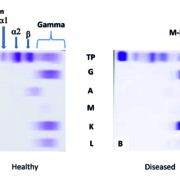
In a healthy immune system, the terminally differentiated white blood B-cells (i.e. plasma cells) each produce a unique immunoglobulin (Ig, or antibody) which was selected for by its fitness to bind to foreign invaders (antigens). This legion of plasma cells resides within our bone marrow and serves as a protective library manufacturing a diverse protective cacophony of Ig proteins whose aim is to protect us from recurrent infections. The total production of Igs in a healthy individual is remarkably highly regulated in the non-infected state with no particular plasma cell out-producing other plasma cells. As a result, the electrophoretic separation of healthy human serum results in a cathodically broad distribution of Ig proteins, which is labelled the gamma region (Fig. 1a).
In contrast, plasma cell proliferative disorders (PCDs) consist of a group of diseases stemming from clonal proliferation of a dysregulated plasma cell clone. PCDs range from relatively common benign conditions, such as monoclonal gammopathy of undetermined significance (MGUS), to frank malignant conditions, such as multiple myeloma (MM) [1]. Central to the detection of PCDs in serum is the detection of the over-produced monoclonal Ig by the dysregulated plasma clone (termed M‑protein or paraprotein). M‑proteins are a relatively common laboratory finding occurring in approximately 3 % of adults over the age of 50 [2]. The majority of these patients will live unaffected by the presence of the M‑protein while some patients will progress to more serious disease, such as MM, at a rate of 1 % per year. Currently, it is not possible to know which patient is going to progress and patients with an M‑protein undergo surveillance for M‑protein concentration changes yearly.
Electrophoresis-based assays
By nature, M‑proteins are heterogeneous and thus diverse methodologies are currently used to detect, characterize and quantitate serum M‑proteins in the clinical laboratory. Serum protein electrophoresis (PEL) was the first method available to detect and quantitate M‑proteins. To increase the specificity and sensitivity, a second technique known as immunofixation electrophoresis (IFE) enables establishment of M‑protein isotype (IgG, IgA, IgM, IgD, IgE or free light chain kappa or lambda) by examining multiple electrophoretic gel lanes in which the serum proteins were ‘fixed’ to the gel using reagents specific for human immunoglobulin components
(Fig. 1). A third assay, the serum free light chain (sFLC) assay, uses specific antibodies for quantitation of circulating free kappa and lambda light chains. This assay has demonstrated superior detection of PCDs, such as amyloid light chain (AL) amyloidosis, which can result from low levels of circulating monoclonal free light chains [3]. Currently, the International Myeloma Working Group recommends a panel of serum tests that include PEL, IFE and a sFLC assay quantitation to maximize the sensitivity of PCD screening [4].
Need for improved detection sensitivity
At our institution, agarose gel electrophoresis methods (PEL and IFE) have been used for detecting M‑proteins since 1967. While the utility of the electrophoretic methods to screen and monitor PCDs has been well established, several changes in the treatment of PCDs are pushing these methods to their analytical limits. Dramatic improvement in the treatment response of MM patients to new chemotherapies and immunotherapies is challenging long-held assumptions about this ominous disease. In particular, there is renewed hope that MM may be curable and perhaps it is time to start treating MM patients until all signs of the disease are eradicated. The long-standing routine serum electrophoretic methods are not capable of providing the analytical sensitivity needed to assess minimal residual disease (MRD). A few laboratorians have turned to using bone marrow biopsies to hunt for traces of the malignant plasma cells by high sensitivity flow cytometry and next-generation sequencing [5, 6]. In addition, new monoclonal therapeutic antibodies (t‑mAbs) designed to eradicate malignant plasma cells are producing interferences making it difficult to distinguish between a patient’s M‑protein and the t‑mAb drug. A search for a more convenient serum-based test to complement bone marrow MRD detection and aid in resolving t‑mAb interferences was sought to address limitations in traditional testing. Mass spectrometry (MS) is aptly suited for this task as the improvements in MS instrumentation and techniques have resulted in increased resolution and mass accuracy that have outpaced improvements in electrophoresis.
MS-based methodsFor Igs, both the overall charge of the protein (the basis of electrophoretic separation) and the mass of the protein (the basis of MS separation) are diverse among Igs owing to Ig gene rearrangement in which the adaptive immune system optimizes the affinity of the antigen binding region of the Ig to its target antigen. The unique amino acid sequence of the antigen binding domain results in a unique molecular mass (and peptide sequence) which is the basis of the mass spectrometric detection. Efforts to optimize M‑protein detection by MS have resulted in two methods differing in the analytical target used to detect the M‑protein. One method based on a tryptic digest of Igs and using selective reaction monitoring (SRM) MS to detect unique peptides from the Ig antigen binding region (also termed the ‘clonotypic’ peptide approach) [7] and a second method based on disassembling Igs by chemical reduction and measuring the mass distribution of Ig light chain [termed monoclonal immunoglobulin Rapid Accurate Mass Measurement (miRAMM)] [8]. Of these two approaches, the miRAMM method was suitable for adaptation to our high volume reference laboratory. The adaptation of the miRAMM method to MALDI-TOF mass spectrometers [9] eliminated the need for chromatography and allowed for throughputs suitable for PCD screening. The simplicity of MALDI-TOF data files also allowed our lab to build software capable of rapidly displaying multiple spectra which can be automatically analysed for an M‑protein. The current clinically validated version of the assay consists of five separate immune-enrichments for IgG, IgA, IgM, kappa and lambda which are separately analysed and the light chain mass distributions are examined for a ‘spike’ in a similar fashion to gel electrophoretic densitometry (Mass-Fix; Fig. 2). Mass-Fix has demonstrated overall superior analytical and clinical sensitivity to serum IFE [9, 10]. Mass-Fix has been automated and validated as a laboratory developed test and our one-year experience has confirmed that the assay is robust, sensitive and more labour efficient than our traditional gel IFE assay.
One of the benefits of using Mas-Fix over electrophoresis is the ability to determine a fundamental feature of the M‑protein, its light chain mass. Reporting the light chain mass allows for a more specific description of M‑protein than is currently available by electrophoresis. Current reporting of serum electrophoresis allows for placing an M‑protein within a region of the electropherorgram (alpha, beta or gamma) which is less specific than reporting an IgG kappa M‑protein with a light chain mass of 23 425 Da. Using the mass of the M‑protein light chain could allow other clinical labs using MS to assess the same patient for over-expressed clones of the same light chain mass increasing the confidence of M‑protein identity. By measuring the mass of the light chain of a t‑mAb, the lab will be able to determining if the detected over-expressed clone is due to the presence of a t‑mAb (such as daratumumab) or the patient’s M‑protein [11]. Additionally, the mass of the M‑protein light chain detected in other body fluids, such as urine, was found to be the same as in serum. This again affords more specificity than is currently available by electrophoresis.
The Mass-Fix assay has also shed light on M‑protein structural features that were not previously appreciated using electrophoretic techniques. In particular, the presence of monoclonal Ig light chains with masses outside the expected mass range were encountered in a small subset of patients. These light chains also had broader mass ranges than typically encountered with M‑proteins. Additional work revealed these light chains contained N-linked glycosylation [12]. Furthermore, patients with light chain glycosylated M‑proteins were found to be more likely to have a rarer form of a PCD (AL amyloidosis) than patients without light chain glycosylation.
Challenges and future perspectives
Challenges remain for these new assays to gain broad acceptance in the medical field. One feature that facilitates acceptance is Conformité Européene (CE) or U.S. Food and Drug Administration (FDA) approval in a format that is scalable and generalizable to a majority of clinical labs. Electrophoretic methods were employed prior to the FDA 510K process and thus have been grandfathered into the FDA approval system. This will not be the case for newer MS assays and thus time will be needed to get FDA approval. With increasing sensitivity, hematologists have also expressed concern over the potential increase in the detection of pre-malignant benign condition MGUS, as this would increase the number of consults.
These challenges need to be assessed in light of the numerous clinical advantages. The addition of the mass measurement allows for simpler conformation of peak as to its origin: disease or t‑mAb, the discovery of new risk factors for the formation of AL amyloidosis, and the ability to standard the detection from lab to lab.
Figure 1. Traditional detection of M-protein by immunofixation electrophoresis. (a) Healthy human serum demonstrating the albumin, alpha 1, alpha 2, beta and the broad gamma region which results from the diverse repertoire of Igs with slightly differing amino acid sequences and hence overall charge. (b) A patient with a plasma cell disorder demonstrating a relatively restricted band in the gamma region with immunofixation with anti-IgG (G) and anti (K) consistent with an IgG kappa M-protein.
Figure 2. Comparison of traditional immunofixation results and the new Mass-Fix spectra. (a) Healthy human serum demonstrating broad gamma region of IFE (left) and normal Gaussian [LC+2] m/z distribution for all immune-enrichments (IgG (black top), IgA (black middle), IgM (black, lower), kappa (orange, all spectra) and lambda (blue, all spectra). (b) A patient with a plasma cell disorder demonstrating a relative restricted band in the gamma region consistent with IgG kappa (left) and a non-Gaussian distribution of light chains with a peak in the IgG light mass distribution (black top) along with same peak in the total kappa light chain mass distribution (orange).
References
1. Willrich MAV, et al. Clin Biochem 2018; 51: 38–47.
2. Kyle RA, et al. N Eng J Med 2002; 346(8): 564–569.
3. Katzmann JA, et al. Clin Chem 2009; 55(8): 1517–1522.
4. Dimopoulos M, et al. Blood 2011; 117(18): 4701–4705.
5. Martinez-Lopez J, et al. Blood 2014; 123(20): 3073–3079.
6. Rawstron AC, et al. J Clin Oncol 2013; 31(20): 2540–2547.
7. Barnidge DR, et al. J Proteome Res 2014; 13(4): 1905–1910.
8. Barnidge DR, et al. J Proteome Re 2014; 13(3): 1419–1427.
9. Mills JR, et al. Clin Chem 2016; 62(10): 1334–1344.
10. Milani P, et al. Am J Hematol 2017; 92(8): 772–779.
11. Mills JR, et al. Blood 2018; 132(6): 670–672.
12. Kumar S, et al. Leukemia 2019; 33(1): 254–257.
The author
David L. Murray MD, PhD
Department of Laboratory Medicine and Pathology, Mayo Clinic, Rochester, MN 55906, USA
E-mail: Murray.David@mayo.edu

Lung cancer has one of the lowest 5-year cancer survival rates as by the time a diagnosis is made, the disease has often reached the late stages. This article discusses how advances in understanding of the genetic evolution of cancer, the combi-nation of biomarker testing and CT scans can improve early diagnosis and touches on the use of biomarkers for improved patient selection for immune checkpoint inhibitor therapy.
by Managing Editor Alison Sleigh PhD
Background
In the UK, lung cancer is the second most common cancer in both men and women, accounting for 13.% of all new cancer cases in 2016 [1], and is the leading cause of death from cancer [2]. These statistics are also reflected in the United States of America [3]. In the UK, 5-year survival rates are low; on average, around 9.%. This is mainly because the majority of patients are already at late stage or metastatic disease at the point of diagnosis [1]. The main cause of lung cancer by far is smoking tobacco cigarettes. However, there are a number of other risk factors that should not be ignored. Environmental risk factors include exposure to radon, asbestos, pollution/poor air quality as well as infection. Genetics also plays a part because not all smokers develop lung cancer and a family history of the disease increases risk by around twofold [3]. In addition, genome-wide association studies have identified a number of chromosome regions that are associated with increased risk of lung cancer. Some of the first regions found have the strongest associations and include 5p15, 15q25-26 and 6p21. Mutations in the 15q25-26 region are linked to increased nicotine dependence and susceptibility for lung cancer. The 5p15 region contains the gene for telomerase reverse transcriptase, and mutations within this gene have been associated with adenocarcinomas in both smokers and non-smokers. Single nucleotide polymorphisms in the BAG6 gene on 6p21 are strongly associated with squamous cell carcinoma (see Bossé and Amos 2018 for a thorough review [4]). Interestingly, although smoking is the major primary cause of lung cancer, around 10–15.% of lung cancer patients have never smoked. Lung cancer in never smokers seems to occur most often in women and younger patients, involving
specific driver mutations such as in epidermal growth factor reductase (EGFR) gene and the echinoderm microtubule-associated protein-like 4 (EML4)–anaplastic lymphoma kinase (ALK) gene fusion, which gives rise to the ELM4-ALK fusion protein.
Diagnosis of lung cancer
Diagnosis of lung cancer usually occurs after a patient presents at a GP clinic with symptoms that can commonly include:
• a persistent cough
• coughing up blood
• persistent breathlessness
• unexplained tiredness and weight loss
• an ache or pain when breathing or coughing.
After this, diagnosis is confirmed by imaging (chest X-ray and then CT scan, and possibly also a PET-CT scan) and biopsy to confirm staging [5].
The challenges with diagnosis are that the early stages of the disease are symptomless; once symptoms become apparent, diagnosis often confirms late stage/metastatic disease, which has low survival rates. In addition, the methods of diagnosis are fairly invasive.
Screening programmes
Low-dose computed tomography (LDCT) screening of people with a higher risk of lung cancer has been trialled but has given with mixed results. Three smaller scale European trials showed non-significant effects or even an increase in mortality [6]. The largest trial, the National Lung Screening Trial, in the USA, showed much more promise with a 20.% reduction in lung cancer mortality [7]. However, the authors also reported an 18.% overdiagnosis rate: of the 24.2.% of patients classified as positive, 96.4.% were actually false positives. This means that 320 people need to be screened to prevent 1 lung cancer death, representing an unacceptable level of screening rounds, exposure to radiation, increased patient anxiety and costs.
Biomarkers
The use of biomarkers could, therefore, be a useful, non-invasive adjunct for identifying true/false positives from initial LDCT screening. Biomarkers can be non-invasively collected, and can come from the tumour itself, the tumour microenvironment as well as the host’s response to the tumour. Properly developed and validated, biomarkers can be diagnostic, prognostic and useful for monitoring therapy. There is, needless to say, a vast amount of research being done to discover such biomarkers for lung cancer and it is outwith the scope of this article to review it all. We will, however, discuss certain aspects of showing promise.
TRACERx: understanding the genetic development of lung cancer with circulating tumour DNA
TProfessor Charles Swanton at the Francis Crick Institute in London, UK, and his team have been analysing circulating tumour DNA (ctDNA) from individual non-small-cell lung cancer (NSCLC) patients through time, mapping the genetic evolution of the disease in a study known as TRACERx [Tracking NSCLC Evolution Through Therapy (Rx)]. In 2017, the initial results of 100 patients from a target group of 842 were published [8]. They found that although driver mutations in EGFR, MET, BRAF, and TP53 were almost always clonal, the heterogeneous driver alterations that occurred later in evolution (found in more than 75.% of the tumours) were common in PIK3CA and NF1 and in genes involved in chromatin modification and DNA damage response and repair. They also found that chromosomal instability was associated with intratumour heterogeneity and that elevated copy-number heterogeneity was associated with a significant increase in risk of recurrence or death [8]. Results from a more recent paper from the same consortium suggest that the immune microenvironment exerts a strong selection pressure in early-stage, untreated NSCLCs that produces multiple routes to immune evasion, which indicates a poor prognosis [9].
Early detection of Cancer of the Lung Scotland: diagnosing lung cancer at an earlier stage with a tumour-associated autoantibodies
The Early detection of Cancer of the Lung Scotland (ECLS) study has just this month made public the results of their randomized controlled trial of Oncimmune’s EarlyCDT®–Lung test on over 12.000 volunteers in Scotland (NHS areas of Tayside, Greater Glasgow and Clyde, and Lanarkshire) [10]. The EarlyCDT®–Lung test is a commercially available ELISA-based blood test that measures a panel of seven tumour-associated autoantibodies: p53, NY-ESO-1, CAGE, GBU4–5, SOX2, HuD and MAGE A4. The volunteers were asymptomatic adults aged between 50 amd 75 who had a high risk of developing lung cancer over the next 24 months. Participants who tested positive were followed up with chest X-ray and non-contrast CT scan. During the study period 127 participants were diagnosed with lung cancer; 41.% of patients from the intervention group who went on to develop cancer were diagnosed with early-stage cancer compared with only 26.8.% from the control group. The results showed that using a combination of the blood test with CT imaging gave a significant decrease in the late-stage diagnosis of lung cancer. The patients will now be followed over the next 5 years to determine mortality outcomes.
Immune checkpoint inhibitor therapy: biomarkers for better patient selection
In recent years, immune checkpoint inhibitor (ICI) therapy has been revolutionizing cancer treatment. This ‘cancer immunotherapy’ uses monoclonal antibodies that typically target programmed death 1 (PD-1), programmed death-ligand 1 (PD-L1), or cytotoxic T-lymphocyte-associated protein 4 (CTLA-4), allowing the restoration of the cytotoxic immune response. However, while some patients respond very well to ICIs, many do not and even go on to develop hyper-progressive disease or immune-related adverse events. Hence, there is a need for biomarkers to aid the selection of patients who will benefit from this treatment. The recent review by Costantini et al. [11] discusses progress that is being made with a variety of types of biomarkers for this purpose, including soluble PD-L1, other soluble proteins (granzyme B, PD-L2, interleukine 2, interferon-gamma), ctDNA, the tumour mutational burden as well as effects of the gut microbiome.
Future perspectives
The work discussed here suggests that very positive steps can be taken towards reducing the mortality rate from lung cancer – probably not from any one aspect alone, but by using many approaches in combination: better biomarker testing will allow an initial screening and improvements in the analysis of CT scans (such as by artificial intelligence [12]) will both help to reduce rates of false positives and minimize the need for unnecessary invasive biopsies. These kinds of improvements may help to generate more cost-effective screening therefore encourage increased role out of lung cancer screening programmes. The rise in popularity of electronic nicotine delivery systems (vaping), particularly in the under 35s, is often thought of as a ‘safe’ way to smoke. However, there have now been 450 cases of a vaping-linked lung illness in the USA, perhaps heralding a need for a different sort of biomarker.
References
1. Lung cancer statistics. Cancer Research UK
(https://www.cancerresearchuk.org/health-professional/cancer-statistics/statistics-by-cancer-type/lung-cancer)
2. Smittenaar CR, Petersen KA, Stewart K, Moitt N. Cancer incidence and mortality projections in the UK until 2035. Br J Cancer 2016; 115(9): 1147–1155.
3. de Groot PM, Wu CC, Carter BW, Munden RF.
The epidemiology of lung cancer. Transl Lung Cancer Res. 2018; 7(3): 220–233.
4. Bossé Y, Amos C. A decade of GWAS results in lung cancer. Cancer Epidemiol Biomarkers Prev 2018; 27(4): 363–379.
5. Lung cancer: diagnosis. NHS website 2019.
(https://www.nhs.uk/conditions/lung-cancer/diagnosis/).
6. Sozzi G, Boeri M. Potential biomarkers for lung cancer screening. Transl Lung Cancer Res 2014; 3(3): 139–148.
7. National Lung Screening Trial Research Team, Aberle DR, Adams AM, Berg CD, Black WC, Clapp JD, Fagerstrom RM, Gareen IF, Gatsonis C, et al. Reduced lung cancer mortality with low-dose computed tomographic screening. N Engl J Med 2011; 365(5): 395–409.
8. Jamal-Hanjani M, Wilson GA, McGranahan N, Birkbak NJ, Watkins TBK, Veeriah S, Shafi S, Johnson DH, Mitter R, et al. Tracking the evolution of non-small cell lung cancer.
N Engl J Med 2017; 376(22): 2109–2121.
9. Rosenthal R, Cadieux EL, Salgado R, Bakir MA, Moore DA, Hiley CT, Lund T, Tanić M, Reading JL, et al. Neoantigen-directed immune escape in lung cancer evolution. Nature 2019; 567(7749): 479–485.
10. Sullivan F. PL02.03 – Early Detection of Cancer of the Lung Scotland (ECLS): trial results. Presented at the 2019 World Conference on Lung Cancer, Barcelona, Spain (https://library.iaslc.org/conference-program?product_id=15&author=&category=&date=2019-09-09&session_type=Plenary%20Session&session=&presentation=&keyword=sullivan&cme=undefined&).
11. Costantini A, Takam Kamga P, Dumenil C, Chinet T, Emile JF, Giroux Leprieur E. Plasma biomarkers and immune checkpoint inhibitors in non-small cell lung cancer: new tools for better patient selection? Cancers (Basel) 2019; 11(9): pii: E1269.
12. Ardila D, Kiraly AP, Bharadwaj S, Choi B, Reicher JJ, Peng L, Tse D, Etemadi M, Ye W, et al. End-to-end lung cancer screening with three-dimensional deep learning on low-dose chest computed tomography. Nat Med 2019; 25(6): 954–961.

Prins Hendrikstraat 1
5611HH Eindhoven
The Netherlands
info@clinlabint.com
PanGlobal Media is not responsible for any error or omission that might occur in the electronic display of product or company data.