
Researchers develop AI-powered biochip that detects cancer-linked genetic markers in just 20 minutes
A nanophotonic biochip paired with deep-learning image analysis can identify multiple microRNA biomarkers with attomolar sensitivity and greater than 99% accuracy – without amplification or enrichment steps. Developed by researchers at Nanyang Technological University, Singapore, the platform detected three lung cancer-associated miRNAs directly from cell extracts in under 20 minutes, which could change how clinicians screen for and monitor a wide range of diseases.
MicroRNAs (miRNAs) have long tantalized clinicians as ideal disease biomarkers – small, stable, and reliably dysregulated in cancer, cardiovascular disease, and metabolic disorders. The catch has always been detection: these 18-23 nucleotide molecules circulate at vanishingly low concentrations, closely related family members share near-identical sequences, and standard qRT-PCR requires laborious enzymatic amplification that limits throughput.
A team led by Associate Professor Yu-Cheng Chen at NTU Singapore’s School of Electrical and Electronic Engineering has now reported a platform that addresses all three problems at once. Published in Advanced Materials on 25 February 2026, it combines a dielectric-metal gap nanocavity with Mask R-CNN deep-learning segmentation to deliver simultaneous, amplification-free quantification of multiple miRNA targets.
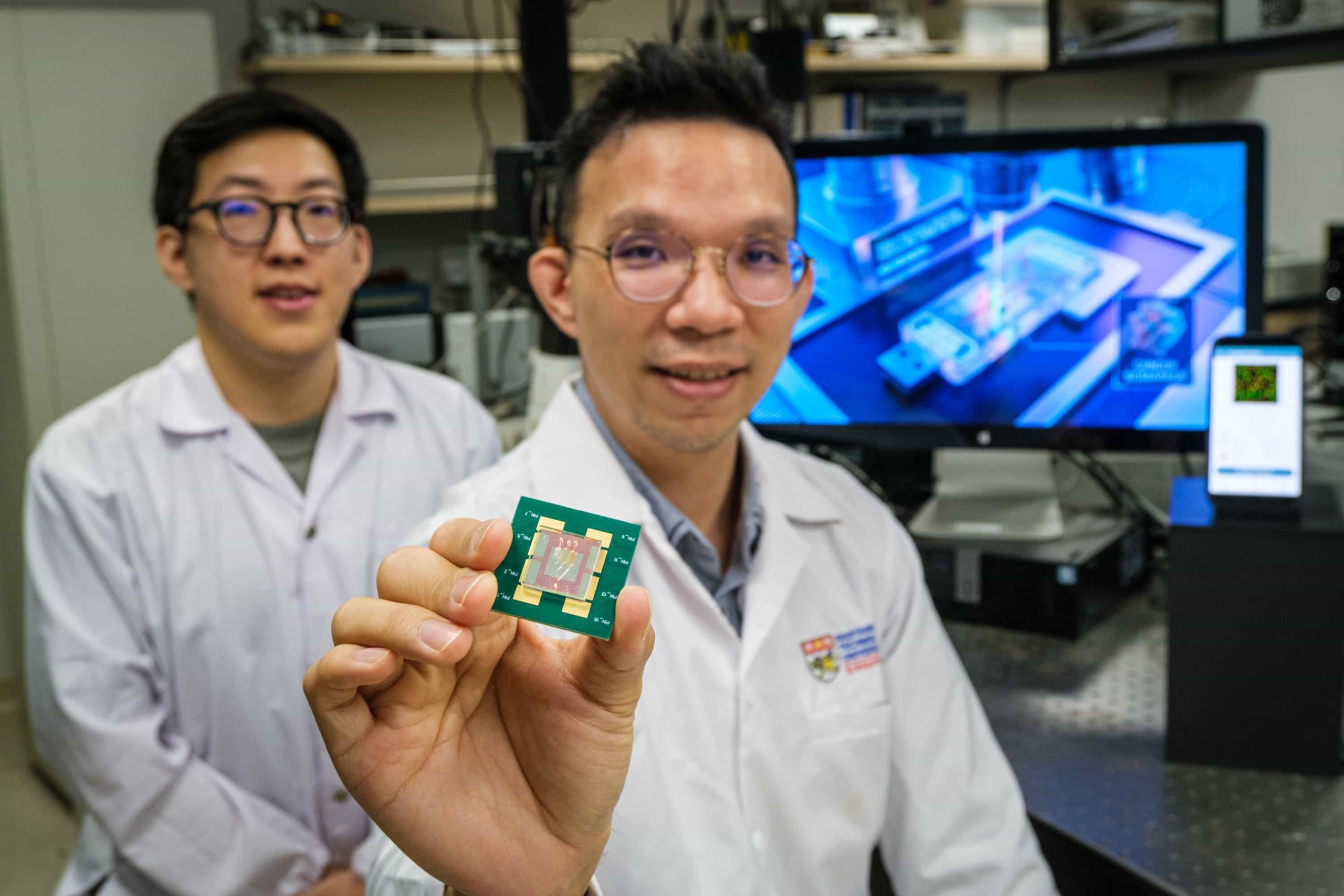
NTU Associate Professor Y.C. Chen (right) holds the new biochip, which can detect miRNA in 20 minutes using AI, with his PhD student Fu Bowen behind him (left).
A nanocavity that works like a hall of mirrors
At the heart of the platform is a 100-nm silver nanoparticle (AgNP) placed on a distributed Bragg reflector (DBR) mirror substrate. The DBR acts as the lower cavity mirror, concentrating excitation and emission fields within the nanogap and achieving approximately a 4.8-fold improvement in collection efficiency compared with a glass substrate, while keeping non-radiative losses low – overcoming a persistent trade-off between light confinement and fluorescence quenching that has limited earlier nanophotonic designs.
The cavity also tames quantum dot (QD) blinking – the intermittent on/off switching of single emitters that has historically confounded digital counting assays. By increasing the radiative decay rate with minimal added loss, it produces sustained, countable fluorescence spots rather than flickering artefacts.
From sample to answer in 20 minutes
The assay runs on a microfluidic chip whose parallel channels are coated with capture oligonucleotides matched to each target miRNA. When a target hybridises, it bridges the surface probe and a QD-AgNP fluorescent probe, completing the nanocavity and generating a colour-coded signal. Three spectrally distinct QDs (550 nm, 590 nm, and 645 nm) are excited simultaneously by a single blue LED, enabling multiplexed readout of miR-191, miR-25, and miR-130a – all three implicated in non-small cell lung cancer (NSCLC) – in a single imaging step. The complete workflow, from sample loading to result, takes just 20 minutes, compared with several hours for conventional PCR-based methods.
AI replaces the microscope eyepiece
Manual counting of fluorescent spots is a recognised bottleneck in nanophotonic biosensing, particularly in dense multiplexed fields. The NTU team addressed this with a Mask R-CNN deep-learning
segmentation model that automatically classifies and counts every QD signal in a single image. At high particle densities it achieved greater than 99% per-class identification accuracy, and automated counts correlated with manual annotation with R² values above 0.99 across all three miRNA channels.
“By combining nanophotonic signal enhancement with AI-based image analysis, we were able to detect tiny amounts of RNA molecules across thousands of nanocavities within minutes,” said Bowen Fu, a PhD student at NTU’s Institute for Digital Molecular Analytics and Science (IDMxS) and first author of the study.
Performance in real biological matrices
The team validated the platform directly on total RNA extracted from A549 human lung adenocarcinoma cells without preamplification or enrichment, recovering endogenous miR-191, miR-25, and miR-130a at concentrations of approximately 10-14 to 10-15 mol/L. Spike-and-recovery experiments returned recoveries of 97–99% across all three targets. The limit of detection reached approximately 10-17 mol/L (attomolar), with a linear dynamic range spanning five orders of magnitude – performance that outstrips many existing miRNA biosensing platforms.
Clinical implications
Independent expert Assoc Prof Sunny Wong Hei, Consultant in the Department of Gastroenterology and Hepatology at Tan Tock Seng Hospital, was direct about the clinical appetite for such technology: “A platform that can accurately detect multiple microRNAs could have huge clinical applications, including earlier detection of cancer, risk stratification of patients, and monitoring of treatment response or disease recurrence. Such a technology could potentially enable more accessible and precise clinical decision-making in oncology and across a range of diseases.”
Prof Chen envisages the platform evolving towards point-of-care deployment via a compact prototype already built, incorporating a colour camera and a mobile phone application. He added that “in the future, it may be possible to use a blood or saliva sample in an automated system that screens for hundreds or even thousands of biomarkers at once. This could support large-scale screening and may help advance personalised medicine.” The team is now seeking collaborations with clinicians and industry to extend validation across broader miRNA panels and additional disease contexts.
Journal reference:
GFu, B., Yang, D., Yuan, Z., et al. (2026). Broadband nanocavity imaging with machine vision for multiplex miRNA assays. Advanced Materials. https://doi.org/10.1002/adma.202522938