


Thermo Fisher launches FTIR microscope for rapid chemical mapping of microscopic samples
Thermo Fisher Scientific has launched the Thermo Scientific™ Nicolet™ RaptIR™ X FTIR Microscope, which combines high-definition optical microscopy with Fourier transform infrared (FTIR) microspectroscopy. The instrument allows users to locate microscopic features within a sample and identify their molecular composition. The company lists applications including the identification of polymers and microplastics, analysis of pharmaceutical formulations, investigation of material failures, and characterisation of materials in forensic, art conservation and geological research.
FTIR microspectroscopy measures how a sample absorbs infrared light, producing a spectrum that acts as a chemical fingerprint. Pairing it with microscopy allows spectra to be collected from defined regions only a few microns across.
Guided workflows for experienced and new users
The microscope builds on 50 years of Nicolet innovation in FTIR spectroscopy and is designed for both experienced spectroscopists and those new to the technique. It is operated through Thermo Scientific™ OMNIC™ Paradigm Software, which provides guided workflows for sample acquisition and analysis.
Ganesh Prasad, General Manager, Vibrational Spectroscopy Products at Thermo Fisher Scientific, said: “The RaptIR X microscope brings the speed, precision and flexibility laboratories need to investigate increasingly complex samples, while making advanced FTIR microscopy easier to use than ever before.” He commented that the platform gives laboratories “the confidence to move from a microscopic observation to a molecular answer, quickly and reliably.”
Speed and resolution
The system can collect up to 10 spectra per second at 5-micron spatial resolution, which supports rapid chemical mapping of large sample areas. This is intended to help users move from sample to results more efficiently. Imaging resolution is 1 micron in the visible range and 5 microns in the infrared, allowing microscopic features to be visualised and their molecular composition identified.
Large samples and reproducibility
A heavy-duty stage accommodates samples up to 40 mm thick and weighing up to 5 kg, which the company says suits laboratories working with large or challenging specimens. Automated detector switching and a fixed detector position are intended to reduce manual intervention and support consistent measurements across different measurement ranges.
Modular configuration
The RaptIR X microscope can operate as a standalone system or be integrated with Nicolet Apex or Nicolet iS50 FTIR spectrometers. Optional capabilities include micro-ATR, polarised visible and infrared analysis, fluorescence visualisation, near-infrared microscopy, grazing angle optics and additional detectors. These allow laboratories to configure the platform as their requirements change.
Thermo Fisher Scientific Inc. reports annual revenue of more than $45 billion (about €39 billion). Its mission it to enable customers to make the world healthier, cleaner and safer, and its brands include Thermo Scientific, Applied Biosystems, Invitrogen, Gibco, Fisher Scientific, Unity Lab Services, Patheon and PPD.
For more information, visit: www.thermofisher.com/raptirx
Digital issue: Please click here for more information
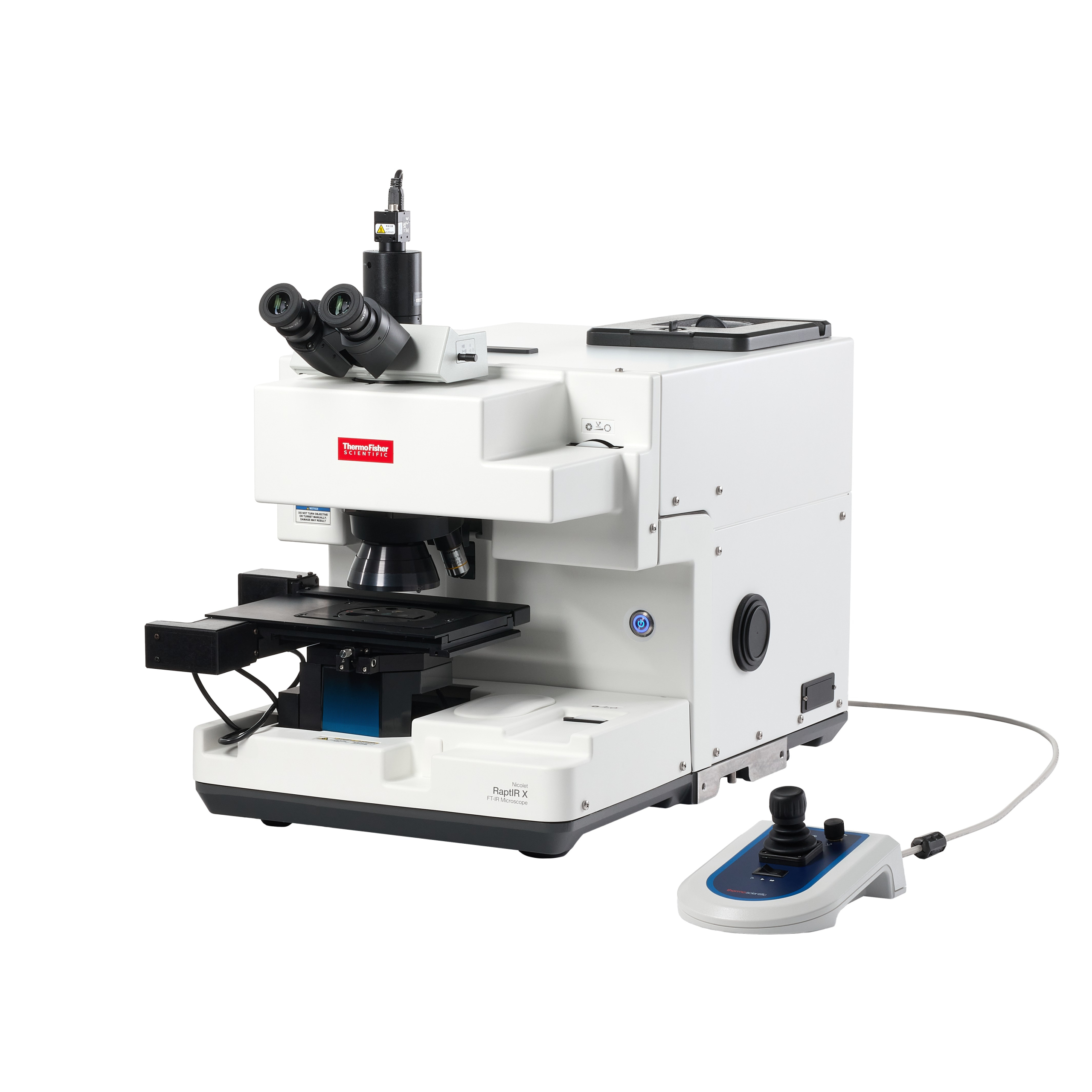
Thermo Fisher Scientific’s new unveiled Nicolet RaptIR X FTIR Microscope