


AI-designed molecules inhibit human enzyme exploited by HIV-1 and SARS-CoV-2
Korea University researchers have benchmarked 13 prediction models and 10 molecule-generation methods against a human enzyme that viruses exploit, then tested six AI-designed compounds in the laboratory. All three predicted-active compounds inhibited the enzyme and all three predicted-inactive compounds did not, though the researchers stress that the hits are early-stage fragments rather than drug candidates, with selectivity and toxicity untested.
Targeting the host rather than the virus
Korea University researchers have built an artificial intelligence (AI) pipeline that designs small-molecule inhibitors of deoxyhypusine synthase (DHPS), a human enzyme that supports viral replication, and have shown in enzymatic assays that its predictions held up. The work was published in the Journal of Cheminformatics on 5 August 2026.
DHPS catalyses the committed step in the hypusine modification of eukaryotic translation initiation factor 5A (eIF5A). Host-directed therapy (HDT) targets such host pathways rather than viral proteins that can mutate and develop resistance. “DHPS is involved in activating eukaryotic translation initiation factor 5A or eIF5A through a unique modification called hypusination. This process is important for the replication of a broad range of viruses, including HIV-1 and SARS-CoV-2, making DHPS a potential target for host-directed antiviral drug discovery,” explained Prof. Kwang Yeon Hwang of the College of Life Sciences and Biotechnology. The best-characterised inhibitor, GC-7, mimics spermidine, which the authors say risks nonselective binding and off-target toxicity.
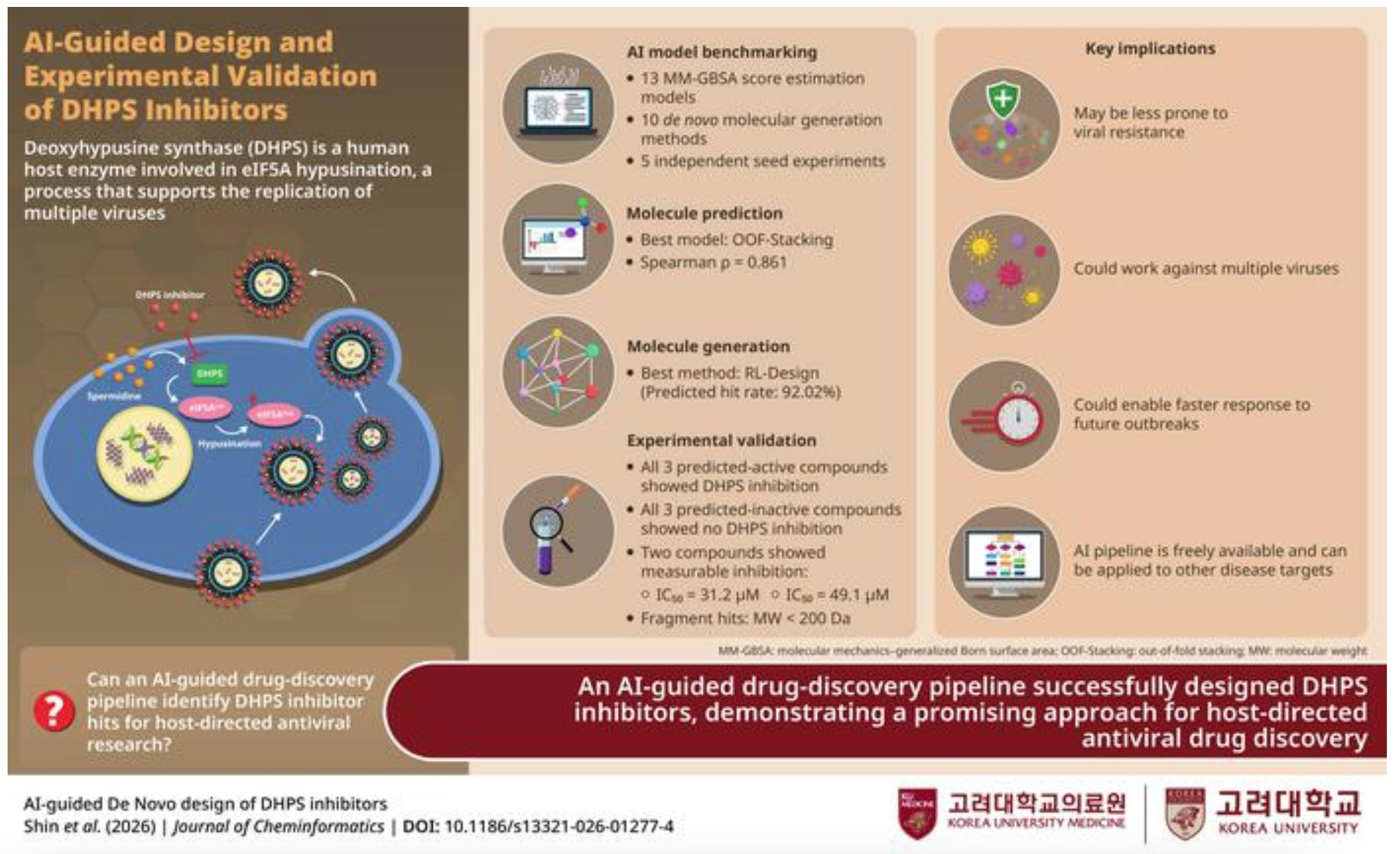
An AI-guided drug-discovery pipeline benchmarked molecular prediction and generation methods to identify potential inhibitors of the human host enzyme deoxyhypusine synthase (DHPS). Six AI-generated compounds were selected for laboratory testing; all three predicted-active compounds showed inhibition, while the three predicted-inactive compounds showed no inhibition. An X-ray co-crystal structure further provided structural evidence for the binding of one compound to DHPS.
IMAGE Credit
Korea University College of Medicine
Benchmarking prediction and generation
The team docked 1,920 commercially available fragments into the crystal structure of human DHPS and scored each with Prime MM-GBSA, a binding-energy estimate used as a proxy label. They compared 13 machine-learning models for predicting these scores under five-seed fivefold cross-validation. Their Out-of-Fold stacking ensemble (OOF-Stacking), which integrates gradient boosting, graph neural network and chemical language models, achieved the highest Spearman rank correlation (0.861 ± 0.008) and the lowest root mean squared error (4.38 ± 0.28 kcal/mol).
Using the ensemble as its scoring oracle, the authors then proposed RL-Design, a reinforcement learning framework, and compared it with nine other generation methods over five independent runs. RL-Design achieved a hit rate of 92.02 ± 0.80% (molecules with a predicted MM-GBSA below −30 kcal/mol) and a high-QED rate of 98.0 ± 4.0% (the share of top-ten molecules with a quantitative estimate of drug-likeness above 0.6). It was also the fastest method, at a mean of 72.7 seconds, 23 times quicker than the flow-based GFlowNet (1,682.1 seconds). Its top-ranked molecules showed no Lipinski Rule of Five violations, and 88.0% of generated molecules had a maximum Tanimoto similarity below 0.4 to the training fragments, indicating structural novelty.
Laboratory validation
Six RL-Design compounds were then tested in an NADH-Glo luminescence assay at 1, 10, 50 and 100 µM: the three highest-reward proposals (predicted active) and the three lowest-reward proposals (predicted inactive). All three predicted-active compounds showed significant inhibition at 100 µM relative to the predicted-inactive group (Welch’s t-test, p<0.001), while the predicted-inactive compounds showed none. Two gave half-maximal inhibitory concentration (IC50) values of 31.2 µM (2-(2-phenylethyl)morpholine) and 49.1 µM (5-methoxy-1,3-dimethyl-1H-pyrazol-4-amine), against 1.9 µM for the GC-7 positive control. The third, 2-methyl-5,6,7,8-tetrahydroquinazolin-6-amine, was weak, with 10.9% inhibition at 100 µM and an IC50 above that range. An X-ray co-crystal structure placed this third compound at the entrance of the NAD-binding pocket, overlapping the spermidine-binding region. The authors write: “Predicted and experimental activity showed complete concordance across all six tested compounds, providing oracle-independent validation of the pipeline.” “Our hits are fragments built on scaffolds unrelated to the known inhibitor. In fragment-based discovery this is exactly where you want to start: they are small and bind efficiently for their size, which leaves considerable room to grow them into more potent compounds. However, these molecules are early-stage hits rather than drug candidates,” noted Associate Professor Hong-Rae Kim of the College of Medicine.
Limitations
The authors acknowledge that, because RL-Design uses OOF-Stacking as its oracle, “these benchmark results reflect performance within the same scoring framework used for optimization.” They add that the study targets hit discovery, so toxicity endpoints “such as AMES mutagenicity, hepatotoxicity, and hERG inhibition were not optimized”. Prof. Kim said: “Further studies will be needed to establish their inhibition mechanisms, selectivity, cellular activity, toxicity and performance in animal models.”
The authors propose extending the pipeline to other RNA viruses such as influenza and dengue, and the code and data are openly available. “The active scaffolds are structurally distinct from GC-7, suggesting new chemical starting points for HDT-based antiviral development,” the authors concluded.
Reference
Shin, H., Bang, K., Park, I., et al. (2026). AI-guided de novo design of DHPS inhibitors. Journal of Cheminformatics, 18, 153. https://doi.org/10.1186/s13321-026-01277-4