




Biomarkers of diabetic nephropathy: A 2017 update
Papadopoulou-Marketou N, Kanaka-Gantenbein C, Marketos N, Chrousos GP, Papassotiriou I. Crit Rev Clin Lab Sci 2017; 54(5): 326–342
Diabetic nephropathy (DN), also named diabetic kidney disease (DKD), is a devastating complication in patients with both type 1 and 2 diabetes mellitus (T1D and T2D) and its diagnosis has been traditionally based on the presence of micro-albuminuria (MA). The aim of this article is to update, through review of the relevant medical literature, the most promising biomarkers for early DKD detection. MA has historically been employed as an early marker of microvascular complications, indicating risk for advanced CKD. However, due to the inability of MA to adequately predict DKD, especially in young patients or in non-albuminuric DKD, additional biomarkers of glomerular and/or tubular injury have been proposed to uncover early renal dysfunction and structural lesions, even before MA occurs. Defining new predictive biomarkers to use alongside urinary albumin excretion (UAE) during the initial stages of DKD would provide a window of opportunity for preventive and/or therapeutic interventions to prevent or delay the onset of irreversible long-term complications and to improve outcomes by minimizing the rates of severe cardio-renal morbidity and mortality in DKD patients.
Urinary angiotensinogen and renin excretion are associated with chronic kidney disease
Juretzko A, Steinbach A, Hannemann A, Endlich K, Endlich N et al. Kidney Blood Press Res 2017; 42(1): 145–155
BACKGROUND/AIMS: Several studies sought to identify new biomarkers for chronic kidney disease (CKD). As the renal renin-angiotensin system is activated in CKD, urinary angiotensinogen or renin excretion may be suitable candidates. We tested whether urinary angiotensinogen or renin excretion is elevated in CKD and whether these parameters are associated with estimated glomerular filtration rate (eGFR). We further tested whether urinary angiotensinogen or renin excretion may convey additional information beyond that provided by albuminuria.
METHODS: We measured urinary and plasma angiotensinogen, renin, albumin and creatinine in 177 CKD patients from the Greifswald Approach to Individualized Medicine project and in 283 healthy controls from the Study of Health in Pomerania. The urinary excretion of specific proteins is given as protein-to-creatinine ratio. Receiver operating characteristic (ROC) curves, spearman correlation coefficients and linear regression models were calculated.
RESULTS: Urinary angiotensinogen [2 511 (196–31 909) vs 18.6 (8.3–44.0) pmol/g, *P<0.01] and renin excretion [0.311 (0.135–1.155) vs 0.069 (0.045–0.148) pmol/g, *P<0.01] were significantly higher in CKD patients than in healthy controls. The area under the ROC curve was significantly larger when urinary angiotensinogen, renin and albumin excretion were combined than with urinary albumin excretion alone. Urinary angiotensinogen (ß-coefficient −2.405, standard error 0.117, P<0.01) and renin excretion (ß-coefficient −0.793, standard error 0.061, P<0.01) were inversely associated with eGFR. Adjustment for albuminuria, age, sex, systolic blood pressure and body mass index did not significantly affect the results.
CONCLUSION: Urinary angiotensinogen and renin excretion are elevated in CKD patients. Both parameters are negatively associated with eGFR and these associations are independent of urinary albumin excretion. In CKD patients urinary angiotensinogen and renin excretion may convey additional information beyond that provided by albuminuria.
KIM-1 Is a potential urinary biomarker of obstruction: results from a prospective cohort study
Olvera-Posada D, Dayarathna T, Dion M, Alenezi H, Sener A et al. J Endourol 2017; 31(2): 111–118
INTRODUCTION: Partial or complete obstruction of the urinary tract is a common and challenging urological condition that may occur in patients of any age. Serum creatinine is the most commonly used method to evaluate global renal function, although it has low sensitivity for early changes in the glomerular filtration rate or unilateral renal pathology. Hence, finding another measurable parameter that reflects the adaptation of the renal physiology to these circumstances is important. Several recent studies have assessed the use of new biomarkers of acute kidney injury (AKI), but the information among patients with stone disease and those with obstructive uropathy is limited.
MATERIAL AND METHODS: A prospective cohort study was conducted to determine the urinary levels of kidney injury molecule-1 (KIM-1), Total and Monomeric neutrophil gelatinase-associated lipocalin (NGAL) in patients with hydronephrosis secondary to renal stone disease, congenital ureteropelvic junction obstruction or ureteral stricture. Comparison between patients with hydronephrosis and no hydronephrosis was carried out along with correlation analysis to detect factors associated with biomarker expression.
RESULTS: Urinary levels of KIM-1 significantly decreased after hydronephrosis treatment in patients with unilateral obstruction (1.19 ng/mL vs 0.76 ng/mL creatinine, P=0.002), additionally KIM-1 was significantly higher in patients with hydronephrosis compared to stone disease patients without radiological evidence of obstruction (1.19 vs 0.64, P=0.006). Total and Monomeric NGAL showed a moderate correlation with the presence of leukocyturia. We found that a KIM-1 value of 0.735 ng/mg creatinine had a sensitivity of 75% and specificity of 67% to predict the presence of hydronephrosis in preoperative studies (95% CI 0.58-0.87, P = 0.006).
CONCLUSION: Our results show that KIM-1 is a promising biomarker of subclinical AKI associated with hydronephrosis in urological patients. NGAL values were influenced by the presence of leukocyturia, limiting its usefulness in this population.
Heparin-binding protein (HBP) improves prediction of sepsis-related acute kidney injury
Tverring J, Vaara ST, Fisher J, Poukkanen M et al. Ann Intensive Care 2017; 7(1): 105
BACKGROUND: Sepsis-related acute kidney injury (AKI) accounts for major morbidity and mortality among the critically ill. Heparin-binding protein (HBP) is a promising biomarker in predicting development and prognosis of severe sepsis and septic shock that has recently been proposed to be involved in the pathophysiology of AKI. The objective of this study was to investigate the added predictive value of measuring plasma HBP on admission to the intensive care unit (ICU) regarding the development of septic AKI.
METHODS: We included 601 patients with severe sepsis or septic shock from the prospective, observational FINNAKI study conducted in seventeen Finnish ICUs during a 5-month period (1 September 2011-1 February 2012). The main outcome measure was the development of KDIGO AKI stages 2–3 from 12 h after admission up to 5 days. Statistical analysis for the primary endpoint included construction of a clinical risk model, area under the receiver operating curve (ROC area), category-free net reclassification index (cfNRI) and integrated discrimination improvement (IDI) with 95% confidence intervals (95% CI).
RESULTS: Out of 511 eligible patients, 101 (20%) reached the primary endpoint. The addition of plasma HBP to a clinical risk model significantly increased ROC area (0.82 vs 0.78, P=0.03) and risk classification scores: cfNRI 62.0% (95% CI 40.5–82.4%) and IDI 0.053 (95% CI 0.029–0.075).
CONCLUSIONS: Plasma HBP adds predictive value to known clinical risk factors in septic AKI. Further studies are warranted to compare the predictive performance of plasma HBP to other novel AKI biomarkers.
Prediction of contrast induced acute kidney injury using novel biomarkers following contrast coronary angiography
Connolly M, Kinnin M, McEneaney D, Menown I et al. QJM. 2017; doi: 10.1093/qjmed/hcx201
BACKGROUND: Chronic kidney disease (CKD) is a risk factor for contrast-induced acute kidney injury (CI-AKI). Contrast angiography in CKD patients is a common procedure. Creatinine is a delayed marker of CI-AKI and delays diagnosis which results in significant morbidity and mortality.
AIM: Early diagnosis of CI-AKI requires validated novel biomarkers.
DESIGN: A prospective observation study of 301 consecutive CKD patients undergoing coronary angiography was performed. Samples for plasma neutrophil gelatinase-associated lipocalin (NGAL), serum liver fatty acid-binding protein (L-FABP), serum kidney injury marker 1 (KIM-1), serum interleukin 18 (IL-18) and serum creatinine were taken at 0, 1, 2, 4, 6 and 48 hours post contrast. Urinary NGAL and urinary cystatin C (CysC) were collected at 0, 6 and 48 hours. Incidence of major adverse clinical events (MACE) were recorded at 1 year. CI-AKI was defined as an absolute delta rise in creatinine of ≥26.5µmol/L or a 50% relative rise from baseline at 48 hours following contrast.
RESULTS: CI-AKI occurred in 28 (9.3%) patients. Plasma NGAL was most predictive of CI-AKI at 6 hours. L-FABP performed best at 4 hours.A combination of Mehran score >10, 4-hour L-FABP and 6-hour NGAL improved specificity to 96.7%. MACE was statistically higher at one year in CI-AKI patients (25.0% versus 6.2% in non CI-AKI patients).
CONCLUSIONS: Mehran risk score, 4 hour serum L-FAPB and 6 hour plasma NGAL performed best at early CI-AKI prediction. CI-AKI patients were four times more likely to develop MACE and had a trebling of mortality risk at 1 year.
Upregulation of long noncoding RNA PVT1 predicts unfavorable prognosis in patients with clear cell renal cell carcinoma
Bao X, Duan J, Yan Y, Ma X et al. Cancer Biomark 2017; doi: 10.3233/CBM-170251
BACKGROUND: Renal cell carcinoma (RCC) is one of the most malignant genitourinary diseases worldwide. Long noncoding RNAs (lncRNAs) are a class of noncoding RNAs in the human genome that are involved in RCC initiation and progression.
OBJECTIVE: To investigate the expression of PVT1 in ccRCC and evaluate its correlation with clinicopathologic characteristics and patients’ survival.
METHODS: Quantitative real-time PCR was performed to examine PVT1 expression in 129 ccRCC tissue samples and matched adjacent normal tissue samples. The relationship of PVT1 expression with clinicopathologic characteristics and clinical outcome was evaluated.
RESULTS: We identified the lncRNA PVT1, which was upregulated in clear cell renal cell carcinoma (ccRCC) tissues when compared with corresponding controls. Furthermore, PVT1 expression was positively associated with gender, tumor size, pT stage, TNM stage, and Fuhrman grade. Kaplan-Meier survival analysis showed that patients with high PVT1 expression had shorter disease-free survival (DFS) and overall-survival (OS) than those with low PVT1 expression, and multivariate analysis identified PVT1 as an independent prognostic factor in ccRCC.
CONCLUSIONS: PVT1 may be an oncogene as well as may promote metastasis in ccRCC and could serve as a potential biomarker to predict the prognosis of ccRCC patients.
Urine S100 proteins as potential biomarkers of lupus nephritis activity
Turnier JL, Fall N, Thornton S, Witte D et al.
BACKGROUND: Improved, non-invasive biomarkers are needed to accurately detect lupus nephritis (LN) activity. The purpose of this study was to evaluate five S100 proteins (S100A4, S100A6, S100A8/9, and S100A12) in both serum and urine as potential biomarkers of global and renal system-specific disease activity in childhood-onset systemic lupus erythematosus (cSLE).
METHODS: In this multicentre study, S100 proteins were measured in the serum and urine of four cSLE cohorts and healthy control subjects using commercial enzyme-linked immunosorbent assays. Patients were divided into cohorts on the basis of biospecimen availability: (1) longitudinal serum, (2) longitudinal urine, (3) cross-sectional serum, and (4) cross-sectional urine. Global and renal disease activity were defined using the Systemic Lupus Erythematosus Disease Activity Index 2000 (SLEDAI-2K) and the SLEDAI-2K renal domain score. Nonparametric testing was used for statistical analysis, including the Wilcoxon signed-rank test, Kruskal-Wallis test, Mann-Whitney U test, and Spearman’s rank correlation coefficient.
RESULTS: All urine S100 proteins were elevated in patients with active LN compared with patients with active extrarenal disease and healthy control subjects. All urine S100 protein levels decreased with LN improvement, with S100A4 demonstrating the most significant decrease. Urine S100A4 levels were also higher with proliferative LN than with membranous LN. S100A4 staining in the kidney localized to mononuclear cells, podocytes, and distal tubular epithelial cells. Regardless of the S100 protein tested, serum levels did not change with cSLE improvement.
CONCLUSIONS: Higher urine S100 levels are associated with increased LN activity in cSLE, whereas serum S100 levels do not correlate with disease activity. Urine S100A4 shows the most promise as an LN activity biomarker, given its pronounced decrease with LN improvement, isolated elevation in urine, and positive staining in resident renal cells.

In 2013, the National Institute for Health and Care Excellence (NICE) published guidelines recommending the use of fecal calprotectin as a screening test for differentiating between inflammatory bowel disease and irritable bowel syndrome. Since then, despite a relatively slow uptake with only a few laboratories offering the test, fecal calprotectin has garnered much interest with more hospitals incorporating it into their pathology services. Therefore, the question of how well primary care is using the service arises. This, along with a brief historical context of inflammatory bowel disease and its diagnosis together with implications of calprotectin testing are discussed here.
by Dr Benjamin Palmer, Dr Wisam Jafar and Steven McCann
Historical context
Inflammatory bowel disease (IBD) is a term used to describe two relapsing chronic gastrointestinal disorders: ulcerative colitis (UC) and Crohn’s disease (CD). Both cause considerable morbidity amongst young patients in whom they occur more frequently [1]. With an estimated prevalence of 2.5–3.0 million people affected in Europe the incidence of IBD is increasing [1]. Although the etiology of IBD is unknown several theories have been put forward the most important and frequently cited elements being: gut microbiota; genetic pre-disposition; environment and immune dysregulation [2]. The two main types of IBD seen in the clinical setting are UC and CD: definitive diagnosis and confirmation is provided by endoscopy and histology. However, in 5% of cases a definitive diagnosis cannot be established: in such cases patients are diagnosed with inflammatory bowel disease unclassified (IBDU) [3, 4].
The gastrointestinal tract is colonized by a large number of diverse bacteria living in symbiosis with their host (microbiota) [5]. Disruption to the diversity and quality of the gut microbiota (dysbiosis) is now implicated in the pathogenesis of both UC and CD [2, 5, 6]. Other important participants are cytokines: as their release causes intestinal inflammation they have been implicated in some of the clinical symptoms such as diarrhea [7–9].
Historically, the two types of IBD were differentiated by the different cytokines and mature CD4+ T helper (Th) cells found elevated in tissue biopsies. UC was characterized by elevated levels of Th2 cells and interleukin (IL)-4, -5, -10 and -13 cytokines, whereas CD was defined by high levels of Th1 cells and the interferon gamma (IFNγ) cytokine [3]. However, new emerging information suggests that it is not as cut and dried as this: emphasis has now shifted towards such pathways as IL-23/IL-17 activation of more pathogenic Th17 cells playing a more significant role in the pathophysiology of not just IBD but other inflammatory diseases [10].
Complicating the clinical scenario is the high prevalence (around 10−20% of the UK population) of an unrelated functional bowel disorder called irritable bowel syndrome (IBS): the true prevalence is thought to be higher as it is suspected that many people may not seek medical advice [11]. Although it does not cause serious morbidities, IBS manifests with symptoms similar to those of IBD, making diagnosis difficult. Unlike IBD, it is not associated with inflammation and, hence, this provides a means of making a differential diagnosis.
Until recently, the diagnosis of IBD was made by clinical evaluation and a combination of biochemical and mainly endoscopic investigations that often involved repeat consultations and testing [3]. This, taken together with an ageing population, an increased public awareness of bowel cancer and the introduction of national screening campaigns has led to increased service demands in endoscopy. The fact that fecal markers, such as calprotectin, are secreted by inflamed intestinal mucosa has led to the development of laboratory assays that can detect gastrointestinal inflammation. It was because of these challenges and recent developments that led the National Institute for Health and Care Excellence (NICE) to publish guidelines on the use of fecal calprotectin in differentiating IBD from IBS in adults provided cancer is not suspected and that local reporting guidelines along with appropriate quality assurance procedures are in place [12]. A cut-off of 50 μg/g is recommended in which all patients with a calprotectin level ≥50 μg/g may be suggestive of IBD and should be referred to Gastroenterology, whereas a calprotectin level <50 μg/g is unlikely to be caused by IBD and should, therefore, be managed with a presumptive diagnosis of IBS [12]. One key study used by NICE in recommending this threshold was carried out by Tibble et al. in which 602 outpatients with lower gastrointestinal tract symptom were included [13]. In this study the authors clearly demonstrated that the IBD group of patients differed significantly (P=0.001–<0.0001) from the IBS group of patients and that a cut-off level of 10 mg/L (equivalent to 50 μg/g) provided optimal diagnostic performance [13]. However, the cut-off level of any test is dependent on the method used and, therefore, each laboratory should establish their method-specific cut-off level [12].
IBD pathway and audit outcome
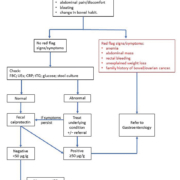
Following the recommendations of NICE, fecal calprotectin testing was incorporated into the pathology services at Stepping Hill hospital on 1 November 2014. The test is available for patients from primary care between 20 and 40 years of age who are presenting with abdominal pain or discomfort, bloating or altered bowel habits for 6 months or longer. Patients with red flag symptoms (anemia, abdominal mass, gastrointestinal infection, rectal bleeding, unexplained weight loss or a family history of ovarian or bowel cancer) should be referred directly to Gastroenterology (Fig. 1).
If the calprotectin test is negative the patient should be managed by primary care with a presumptive diagnosis of IBS; if the test is positive the patient should be referred to Gastroenterology. Then in 2016 a 1-year retrospective audit was carried out with the aim of determining how well primary care was adhering to the clinical pathway [14]. In order to achieve this, a questionnaire was designed and sent to all primary care surgeries in the catchment area for each patient who received calprotectin testing (n=587): the responses (n=217) to these questionnaires were then compared to the IBD pathway [14].
The outcome of this audit revealed that most areas of the IBD pathway were not being adhered to and, therefore, GP re-education and training was needed; a similar finding to another hospital [10]. The worst area of non-conformance was to ensure that patients had had signs/symptoms for at least 6 months: 69% of requests were not compliant [14]. Exclusion of gastrointestinal infection was second (63%), followed by ensuring age was 20–40 years (48%) [14]. Of the 216 questionnaires returned, 35% of patients had had red flag signs/symptoms at the time of the request [14]. Alarmingly, rectal bleeding was the most frequently encountered, followed by anemia, unexplained weight loss and a family history of bowel/ovarian cancer [14]. None of the patients had abdominal mass [14]. Conversely, high compliance was observed for the withdrawal of non-steroidal inflammatory drugs (NSAIDs) and antibiotics before testing [14]. Overall, only 24 requests (11%) were fully compliant for all criteria of the IBD clinical pathway [14].
Patient/clinician considerations
Unlike other fecal markers such as elastase, calprotectin is much less stable (up to 3 days at room temperature) and, therefore, it is important that patient samples are sent to the laboratory within 72 hours of collection [16]. It is still the case that samples are received by the laboratory with no date or time of collection and these are consequently rejected for analysis. Considering that calprotectin is elevated in gastrointestinal infection, in order for the test to be of clinical use, it is imperative that this is excluded.
The age restriction imposed on calprotectin testing is important and is based on the fact that IBS is more common in younger adults, that the prevalence of IBS decreases with increasing age and that new onset of symptoms after 50 years is uncommon [11, 17]. By focusing on this age group a large number of patients who do not require diagnostic testing will be excluded and, therefore, they will not add to the delay that current IBD sufferers face in receiving a colonoscopy.
Patients >40 years of age should be referred to Gastroenterology without delay, as the risk of developing colorectal cancer increases with age: colorectal cancer is the third most commonly diagnosed cancer in the UK and one of the major complications of IBD [18].
Since IBD is a relapsing disease the clinician should be aware that screening results from some patients with IBD may be negative, particularly if the disease is in a period of remittance and, therefore, the presentation of the patient, not the test result, should be the ultimate deciding factor over whether to refer. Finally, underpinning this is the need for local laboratories to determine their own method-specific cut-off values using evidence-based medicine. As with all screening tests the aim should be to optimize the test’s ability to exclude disease (IBS) so that fewer patients without disease are referred.
References
1. Trbojevic Akmacic I, Ventham NT, Theodoratou E, Vuckovic F, Kennedy NA, Krištic J, Nimmo ER, Kalla R, Drummond H, et al. Inflammatory bowel disease associates with proinflammatory potenial of the immunoglobulin G glycome. Inflamm Bowel Dis 2015; 21: 1237–1247.
2. de Souza HS, Fiocchi C. Immunopathogenesis of IBD: current state of the art. Nat Rev Gastroenterol Hepatol 2016; 186: 13–27.
3. Odze R. Diagnostic problems and advances in inflammatory bowel disease. Mod Pathol 2003; 16(4): 347–358.
4. Magro F, Giochetti P, Eliakim R, Ardissone S, Armuzzi A, Barreiro-de Acosta M, Burisch J, Gecse KB, Hart AL, et al. Third European evidence-based consensus on diagnosis and management of ulcerative colitis. Part1: definitions, diagnosis, extra-intestinal manifestations, pregnancy, cancer surveillance, surgery and ileo-anal pouch disorders. J Crohns Colitis 2017; 11(6): 649–670.
5. Salim SY, Söderholm JD. Importance of disrupted intestinal barrier in inflammatory diseases. Inflamm Bowel Dis 2011; 17(1): 362–381.
6. Ni J, Wu GD, Alenberg L, Tomov VT. Gut microbiota and IBD: causation or correlation? Nat Rev Gastroenterol Hepatol 2017; 14(10): 573–584.
7. Neurath MF. Cytokines in inflammatory bowel disease. Nat Rev Immunol 2014; 14(5): 329–342.
8. Műzes G, Molnár B, Tulassay Z, Sipos F. Changes of the cytokine profile in inflammatory bowel diseases. World J Gastroenterol 2012; 18(41): 5848–5861.
9. Ohama T, Hori M, Sato K, Ozaki H, Karaki H. Chronic treatment with interleukin-1β attenuates contractions by decreasing the activities of CPI-17 and MYPT-1 in intestinal smooth muscle. J Biol Chem 2003; 278(49): 48794–48804.
10. Iwakura Y, Ishigame H. The IL-23/IL-17 axis in inflammation. J Clin Invest 2006; 116(5): 1218–1222.
11. National Institute for Health and Care Excellence (NICE). Irritable bowel syndrome in adults: diagnosis and management of irritable bowel syndrome in primary care. NICE Clinical Guideline 61, 2008 (https://www.nice.org.uk/guidance/cg61).
12. NICE. Faecal calprotectin diagnostic tests for inflammatory diseases of the bowel. NICE Diagnostics Guidance 11, 2013 (https://www.nice.org.uk/guidance/dg11).
13. Tibble J, Teahon K, Thjodleifsson B, Roseth A, Sigthorsson G, Bridger S, Foster R, Sherwood R, Fagerhol M, Bjarnason I. A simple method for assessing intestinal inflammation in Crohn’s disease. Gut 2000; 47: 506–513.
14. Palmer B, McCann S. A one year retrospective audit on calprotectin: how well is primary care adhering to the pathway for inflammatory bowel disease. Poster presented at Focus 2017, the Association of Clinical Biochemistry national annual meeting.
15. Turvill J. Evaluation of guidelines for the use of faecal calprotectin testing in primary care. NICE 2015. (https://www.nice.org.uk/sharedlearning/evaluation-of-guidelines-for-the-use-of-faecal-calprotectin-testing-in-primary-care).
16. Tøn H1, Brandsnes, Dale S, Holtlund J, Skuibina E, Schjønsby H, Johne B. Improved assay for faecal calprotectin. Clin Chim Acta 2000; 292: 41–54.
17. Halland M, Saito YA. Irritable syndrome: new and emerging treatments. BMJ 2015; 350: h1622.
18. Adelstein B, Macaskill P, Chan SF, Katelaris PH, Irwig L. Most bowel cancer symptoms do not indicate colorectal cancer and polyps: a systematic review. BMC gastroenterol 2011; 11: 65–74.
The authors
Benjamin Palmer*1 PhD, MRSC; Wisam Jafar2 MBChB, MRCP(gastro), MSc, MA, FRCP; Steven McCann2 MSc, FRCPath
1Betsi Cadwaladr Health Board, Glan Clwyd Hospital, Rhyl, Denbighshire, Wales, UK
2Stockport NHS Foundation Trust, Stockport, Cheshire, UK
*Corresponding author
E-mail: Ben.palmer@wales.nhs.uk

October 2nd marked the 100th anniversary of the birth of Christian de Duve, Nobel Prize-winning Belgian cytologist and biochemist who discovered two cell organelles, lysosome (in 1955) and peroxisome (in 1966), for which he shared the 1974 Nobel Prize in Physiology or Medicine with fellow Belgian Albert Claude and Romanian-born American George Palade. The award recognized their ‘discoveries concerning the structural and functional organization of the cell’. Albert Claude pioneered the application of electron microscopy for the study of animal cells and developed the technique of differential centrifugation during the 1930’s and 40’s at the Rockefeller Institute while George Palade discovered what are now known as ribosomes, further demonstrating their role in protein synthesis and describing the protein secretory process. De Duve’s work was a direct consequence of Claude’s contributions in the chemical fractionation of cell components and his discovery of lysosomes laid the groundwork for the understanding of the mechanisms of several metabolic disorders such as Pompe disease and Gaucher disease. These rare diseases are grouped together under the name of Lysosomal Storage Disorders (LSDs), a group of approximately 50 inherited metabolic disorders resulting from defects in lysosomal function which affect mostly children who often die at a young and unpredictable age.
Although there are currently no cures for LSDs (despite the promises of gene therapy) and treatment is mostly symptomatic, enzyme replacement therapy (ERT) has been shown to minimize symptoms and prevent permanent organ damage. Early detection is therefore critical to allow treatment and control of these rare disorders in newborns and depends on the availability of accurate screening tests. The US FDA has recently cleared a neonatal screening test for Mucopolysaccharidosis Type 1 (MPS I), Pompe disease, Gaucher disease and Fabry disease through the de novo premarket review pathway. The Seeker system (which is also CE-marked and manufactured by Baebies, Durham, NC, USA) consists of a reagent kit and instrument for measuring the activity of enzymes associated with any of the four LSDs in dried blood samples collected from the prick of a newborn’s heel 24 to 48 hours after birth.
None of these developments would be possible without advances in fundamental research and, unfortunately, Europe is still lagging behind the US and possibly China in this respect. In Belgium, a major research funding organization (the FNRS, founded in 1928) recently announced it could only finance 20% of grant requests although 60% were qualified as exceptional or excellent. It is high time for European governments and institutions to heed the late Professor de Duve’s words: ‘To overcome disease one must first understand it’.

The best outcomes in cancer treatment can be achieved with early diagnosis. Prostate-specific antigen (PSA) is unique in that it is the only tissue-specific biomarker that can aid in the early diagnosis of cancer, in addition to its use for post-treatment monitoring. PSA is only expressed in prostate tissue and, in combination with a digital rectal examination (DRE), is an effective screening tool for the diagnosis and early detection of prostate cancer.
Although controversy continues to surround the use of PSA testing as a screening aid, much of that actually relates to misconceptions about how to implement PSA and how best to follow-up on a suspicious test result. The dramatic spike in prostate cancer detection and decline in mortality due to prostate cancer that accompanied the introduction of PSA screening in the early 1990s, and the results of more recent long-term studies in large patient populations are evidence of the value of PSA testing when properly understood and applied.
Prostate cancer represents 27% of all cancers in men and is the second deadliest form of cancer in this population. In 2016, an estimated 26,000 men died of prostate cancer. The disease is especially prevalent among African-American men and men who have first-degree relatives with prostate cancer. More aggressive prostate cancer tends to occur more often in younger men….
Download white paper to continue reading
March 2026


Prins Hendrikstraat 1
5611HH Eindhoven
The Netherlands
info@clinlabint.com
PanGlobal Media is not responsible for any error or omission that might occur in the electronic display of product or company data.