



Although globally prostate cancer (PCa) is the second most common cancer in men after lung cancer, and around one in six men in the West will eventually be diagnosed with the disease, the majority of these patients will die of unrelated causes. Thus PCa management should ideally not only involve diagnosis and provision of the most appropriate therapy, but also a decision as to whether any treatment is actually necessary.
Traditional screening based on an elevated level (above 4ng/mL) of the far from specific marker Prostate Specific Antigen (PSA) to diagnose PCa has led to over-diagnosis, unnecessary biopsies and over-treatment. It has also led to PCa cases with PSA levels below the cut-off value remaining undetected. The phi test, available in Europe since 2010 and very recently approved by the FDA, was developed to improve prostate cancer management. Intended for use in men with a PSA level in the range of 4 – 10 ng/mL, the test combines measurements of total PSA, free PSA and an isoform of free PSA, namely [-2]pro-PSA, to determine the probability of prostate cancer. The test does help to discriminate between PCa and benign disease, and reduces the number of negative prostate biopsies.
However many elderly men diagnosed with a tumour confined to the prostate gland that would not have affected their survival are still undergoing aggressive and unnecessary therapy; the majority of these patients suffer from erectile dysfunction after treatment and many have urinary leakage and intestinal problems. There is still a major need for accurate, preferably blood tests to determine which elderly patients with PCa currently confined to the prostate gland are likely to suffer eventually from life-threatening metastatic prostate cancer.
Two papers published in the October issue of The Lancet Oncology give cause for optimism, however. It was found that whole blood gene profiling in men with metastatic castration-resistant prostate cancer (defined as disease progression despite androgen depletion therapy) was able to stratify patients into two distinct prognostic groups. In addition the European Medicines Agency (EMA) is about to approve a new drug, Enzalutamide, to be taken orally once a day, for the treatment of metastatic castration-resistant prostate cancer. Data from Phase III clinical trials show that as well as extending life in sufferers, the drug also improves quality of life by reducing pain and increasing appetite and energy levels.
Hopefully at least some of the unnecessary suffering resulting from PCa management will soon be alleviated.

The worldwide prevalence of obesity (defined as a BMI greater than 30) has more than doubled in the last thirty years, largely as a result of lifestyle changes leading to many people having a greater energy intake than expenditure. According to a study published in The Lancet recently, with the exception of populations in sub-Saharan Africa, over-eating is now a more serious health risk than eating too little. Globally three million people per year die as a result of obesity, three times the number who die from malnutrition.
There is also an increasing prevalence of vitamin D insufficiency and deficiency, particularly in developed countries. For example, according to a recent article published in the British Medical Journal, more than half the adult population in the UK is vitamin D insufficient, and 16% are severely deficient in the winter and spring; alarmingly up to a quarter of UK children are vitamin D deficient. This growing public health problem is also largely the result of lifestyle changes. Endogenous synthesis through exposure of the skin to sunlight is the major source of vitamin D; dietary sources are limited. Today’s children and adolescents tend to spend less time outside than previous generations, and the message that over-exposure to sunlight increases the risk of melanoma has lead to general over-cautiousness. While the role of vitamin D in regulating calcium and phosphorus and in the mineralization of bone has long been established, more recent work has linked vitamin D deficiency to a range of conditions including untoward pregnancy outcomes, diabetes, cancer, cardiovascular disease and autoimmune diseases. Previous observational studies also noted a link between obesity and vitamin D deficiency, but studies on vitamin D supplementation and weight loss yielded inconsistent results; it was not known which of the conditions was the cause and which the effect.
Now a meta-analysis involving a total of over 42,000 people of European ancestry from six different countries has been published. Twelve SNPs related to BMI and four SNPs associated with vitamin D formulation were analysed in normal weight, overweight and obese subjects. The results indicate that a higher BMI leads to lower vitamin D levels, probably because this vitamin is fat-soluble, but that higher vitamin D levels have no effect on obesity.
It would thus be prudent to monitor vitamin D status in obese subjects and give supplementation if needed, but encouraging lifestyle changes to incorporate regular exercise outdoors would kill two birds with one stone and would be of benefit to all of us!


Increasingly sophisticated instruments and an expanding range of fluorochromes are making it possible to detect an increasing number of markers on a single cell. These advances are encouraging the wider adoption of polychromatic flow cytometry (PFC). This review looks at the benefits of PFC in clinical laboratories, and how to deal with the associated challenges.
by Sandy Smith and Professor William Sewell
Flow cytometry is a valuable tool in today’s diagnostic pathology laboratories [1]. The main strengths of flow cytometry are the ability to detect and characterise abnormal populations, the capacity to assess several markers simultaneously on the one cell and the relative speed with which results can be produced. In recent years, there has been a progressive introduction into clinical laboratories of polychromatic flow cytometry (PFC), using instruments that detect 5–10 markers simultaneously. This paper will focus on how increasing colours can impact a clinical flow cytometry laboratory.
The advantages of PFC
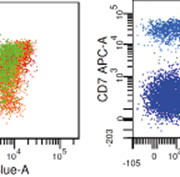
Arguably the biggest impact of increasing colours is the exponential increase in the amount of information obtained from paucicellular samples, such as cerebrospinal fluid (CSF). Often all the sample needs to be committed to a single tube to obtain enough events. Studies have shown flow cytometry improves the detection rate of CSF involvement of haematopoietic neoplasms [2]. With low cell numbers, background events become a significant proportion of total events, thus having sufficient colours available to include a nuclear stain can be very useful to identify true cells from debris. Another major benefit of increased colours is in the analysis of complex populations [3]. Light chain expression is the key to demonstrating monoclonality on B cell populations, so the more markers in the light chain tube, the better the sensitivity. The availability of more markers increases the ability to separate populations and analyse them independently. T cell phenotyping is significantly more complex than for B cells [4], and PFC can improve the effectiveness of panels investigating T cell disorders. However specificity becomes an issue since there are often many T cell subsets in reactive samples. CD7 negativity is used to identify some T-NHL cells, however CD7 negative populations are commonly found in normal samples. False negativity can be reduced by appropriate selection of clones and fluorochromes, and we have found that switching CD7 from FITC to APC has reduced the amount of dim-negative populations [Fig. 1]. However, T cell malignancies are relatively rare thus would rarely justify an instrument upgrade alone. PFC can aid in the detection of minimal residual disease (MRD) populations, by allowing the inclusion of more markers to identify targeted populations. In recent years, MRD detection has benefitted from developments in instrumentation that improve consistency in settings over different collection time points, and improved computers and software packages that allow fast analysis of >500,000 events. As these technologies are more widely adopted, the benefits of PFC will have a greater impact in MRD detection. PFC has made panel construction both easier and harder. Using more colours means fewer decisions when assigning markers to tubes, but this will be limited by the range of conjugates for rarer fluorochromes, and complicated by compensation and spreading. Sorting out compensations for overlapping fluorochrome emissions does become more complex with more fluorochromes, but is reduced when they are excited by different lasers. With advances in software, compensation can be managed with automated matrices and manual optimisation by experienced users. Although there is an increased range of fluorochromes, it is helpful to use one fluorochrome per channel (i.e. always FITC or always AF488) to avoid generating and maintaining too many separate settings files. The spreading effect is the expansion either side of the zero point of an axis due to the bright positive intensity of a second fluorochrome [Fig. 2]. This phenomenon is unique to instruments producing digital data, and can be managed by arranging mutually exclusive combinations on affected fluorochromes [5].
Quality control
Increasing the number of colours does not increase the number of QC procedures, however these can become more complex as there are more things that could go wrong. No matter how many colours are used, any lab will still need daily bead calibration to ensure consistent instrument operation, plus a biological control to ensure appropriate assay and acquisition set up. Upgraded instruments will have more detectors, lasers and fluorochromes to check, therefore a greater knowledge base is required to troubleshoot problems. Labs with the expertise to resolve technical issues in-house will have less instrument downtime. For biological controls, a very effective form of QC is to utilise internal controls, which are negatively stained cells in the same sample. These are independent of the number and type of fluorochromes used and are especially useful in high throughput labs.
Data handling
As the number of colours increase, the information becomes harder to express in traditional graphic form [6]. Standard graphs are two-dimensional; gates can be combined in Boolean formulas, but each region is still adjusted in two dimensions. The number of graphs required to display each marker against each other marker increases. Careful planning should enable each lymphocyte marker to be shown only once for each tube in panels targeting lymphocyte lineage neoplasms, reducing the time taken to review data. In myeloid panels the emphasis is on tracking development pathways, thus some markers are required to help track multiple pathways. For example, CD33 is useful for blasts, and for both monocytic and granulocytic development. Another strategy to clarify data is to use colour schemes to track cells on different 2D plots from one tube; these schemes can then be applied to all tubes in the panel to help tie the information together. Traditionally, analysis software has been provided by the cytometer manufacturer. However, the increased complexity of analysis in PFC means that specialist software companies are playing a greater role. For the next stage of software development, many of these companies are developing complex algorithms to define clusters of cells in multi-dimensional space in a way that the traditional approach of sequential gating cannot. However the main issue seems to be around expression of the data in a user friendly way so that subtle populations can be visualised in a persuasive fashion.
Technology development
In recent years, there have been efforts to standardise antibody panels. Increasing colours can make the choice of which markers to combine in the same tube easier, and allows ‘backbone’ markers to be included. Backbone markers refer to markers used in every tube of a panel to allow more specific gating across tubes; an example of B cell panel markers in multiple tubes is shown in Table 1. Various international groups have recommended approaches to standardisation [7]. However adoption has been slow, likely for practical reasons. Increasing colours increases information, but also complexity of analysis and range of technical issues, thus staff need to have a greater knowledge and experience. This issue is worthy of its own paper so is not discussed in depth here; major issues are listed in Table 2. Labs tend to use reagents recommended by their instrument manufacturer which makes technical support easier. The appropriate number of colours and most suitable instrumentation for each laboratory is very site specific, which decreases the capacity for standardisation. It is desirable, and indeed more practical, to standardise user expertise; the implementation of the International Cytometry Certification Examination is a significant first step.
Fluorochrome availability and cost
The average number of colours used in the clinical world depends on both suppliers and labs. It requires a critical mass of usage from laboratories to make a larger range of fluorochromes and conjugates commercially viable. As the increased range is more widely adopted, experience increases and more suppliers take on larger ranges, thus prices may be reduced; both of which encourage more laboratories to upgrade their systems, and so on. This cycle relies on both commercial investment in new technologies, as well as laboratories investing resources to trial and optimise these technologies. In labs this tends to rely on individuals being personally motivated plus supported by the lab, which is difficult in the current economic climate. One solution is for multiple sites to pool resources, for one centre to investigate and implement options, which can then be adopted and optimised by all. Also, research groups will concentrate resources into creating single panels to glean maximum information from samples. Here, the more unusual fluorochromes and instruments can be tested and optimised, and these experiences passed onto clinical users.
Conclusion
Practicalities and cost effectiveness will always play a part in the future directions of clinical flow cytometry labs. There are many benefits to increasing the colour capabilities of clinical labs. More information can be taken from each assay tube improving sensitivity for abnormal populations in a normal or reactive background and in the analysis of paucicellular specimens. Workflow can also improve with fewer tubes to run. More colours will potentially lead to more technical issues and more resources for trial and validation; ultimately the availability of resources will dictate the appropriate number of colours for each laboratory. Labs should regularly assess how many colours would be of benefit to them, and how many colours they can handle. These developments will continue to enhance the contribution of flow cytometry to laboratory diagnosis.
References
1. Craig FE, Foon KA. Blood 2008; 111: 3941–3967.
2. de Graaf MT, de Jongste AH, et al. Cytometry B Clin Cytom 2011; 80: 271–281.
3. Sewell WA, Smith SA. Pathology 2011; 43: 580–591.
4. Tembhare P, Yuan CM, Xi L, et al. Am J Clin Pathol 2011; 135: 890–900.
5. Roederer M. Cytometry 2001; 45: 194–205.
6. Mahnke YD, Roederer M. Clin Lab Med 2007; 27: 469–485, v.
7. Davis BH, Holden JT, et al. Cytometry B Clin Cytom 2007; 72(S 1): S5–13.
The authors
Sandy ABC Smith1 MSc, and William A Sewell1,2,3 MBBS, PhD
1 Immunology Department, SydPath, St Vincent’s Pathology, St Vincent’s Hospital Sydney, Victoria St, Darlinghurst, NSW 2010, Australia.
2 St Vincent’s Clinical School, University of NSW, NSW 2052, Australia.
3 Garvan Institute of Medical Research, Victoria St, Darlinghurst, NSW 2010, Australia
Two novel biochemical tests, the ESBL NDP and the Carba NP tests, have been recently developed for the early detection of ESBL- or carbapenemase resistance traits in Enterobacteriaceae. Those tests are rapid, sensitive, specific and cost-effective. Implementation of those tests in clinical microbiology laboratories may significantly improve the management and outcome of patients.
by Dr L. Dortet, Dr L. Poirel and Prof. P. Nordmann
Multidrug resistance is now emerging worldwide at an alarming rate among Gram negatives bacteria, causing both community-acquired and nosocomial infections [1–3]. One of the most important emerging resistance traits in Enterobacteriaceae corresponds to the acquisition of resistance to broad-spectrum β-lactams, which is mainly associated with production of clavulanic acid inhibited extended-spectrum β-lactamases (ESBLs) [4, 5]. An ESBL is a β-lactamase that confers reduced susceptibility, i.e. resistance, to the oxyimino-cephalosporins (e.g. cefotaxime, ceftriaxone, ceftazidime) and monobactams (e.g. aztreonam). The hydrolytic activity of ESBLs can be inhibited by several β-lactamase inhibitors such as clavulanic acid and tazobactam. Noteworthy, ESBLs usually do not hydrolyse cephamycins (e.g. cefoxitin and cefotetan) and carbapenems (imipenem, meropenem). In the context of worldwide spread of multidrug resistance, ESBL producers that are mostly Escherichia coli and Klebsiella pneumoniae are not only found as source of hospital-acquired but also of community-acquired infections [4-6]. Consequently, the last line of therapy, carbapenems, is now frequently needed to treat severe infections. However, carbapenem-non-susceptible Enterobacteriaceae due to the production of a carbapenem-hydrolysing enzymes termed carbapenemases, have been reported increasingly [1, 7, 8], leaving us with almost no effective molecules.
Thus, the early detection of ESBL and carbapenemase producers in clinical microbiology is now of utmost importance for determination of appropriate therapeutic schemes and the implementation of infection control measures.
Recently, we have developed two novel tests for rapid identification of (i) ESBL-producing Enterobacteriaceae (ESBL NDP test) [9] and (ii) carbapenemase-producing Enterobacteriaceae and Pseudomonas spp. (Carba NP test) [10–12]. We discuss here the clinical value of those tests.
Detection of ESBLs: Place of the ESBL NDP test in the diagnostic armamentarium
Current techniques for detecting ESBL producers are based on the determination of susceptibility to expanded-spectrum cephalosporins followed by the inhibition of the ESBL activity, mostly by clavulanic acid or tazobactam [13]. The double-disk synergy test, the “E-test” ESBL and the combined disk method have been proposed for that purpose. All those techniques consist of the identification of a synergy between an extended-spectrum generation cephalosporin (ESC) and an inhibitor of β-lactamase (i.e. clavulanic acid or tazobactam) after 18–24h of growth on Mueller-Hinton agar.
This synergy is visualized by (i) a “bouchon de champagne”-shaped image between the extended-spectrum generation cephalosporin and the clavulanate-containing disks for the double-disk synergy test, by (ii) a difference of minimal inhibitory concentration of more than three dilutions between ESC alone and association clavulanate-ESC for the “E-test” ESBL and by (iii) a difference of inhibition diameter of more than 5 mm between an ESC-containing disk and a combined disk containing the same ESC plus clavulanate.
Sensitivities and specificities of the double-disk synergy test and of the E-test are good, ranging from 80 to 95% [13]. However, due to the large diversity of ESBLs [6] that do not hydrolyse ESC similarly, several combinations of those molecules (cefotaxime, ceftazidime and cefepime) together with clavulanate should be tested. Based on the same principle, automated methods for bacterial identification and susceptibility testing are also used in the detection of ESBL-producing organisms. The performance of those systems varies and differs depending on the species investigated with a much higher sensitivity (80–99%) than specificity (50–80%) [13]. However, those tests require mostly overnight growths after isolation of the bacteria, meaning that up to 24–72 h can elapse before ESBL production is detected once the isolate has grown.
Molecular methods (PCR, hybridization, sequencing) based on the detection of ESBL genes have been developed as an alternative. Although classical PCR and DNA arrays necessitate isolation of the bacteria from the clinical sample, real-time PCR based techniques may be performed directly on clinical samples, leading to a decrease of the detection delay. However, these molecular techniques remain costly and require a certain degree of expertise, which is not accessible to non-specialized laboratories. Additionally, those detection methods are able to detect only known genes. They are usually not performed in a routine laboratory but restricted to epidemiological purposes.
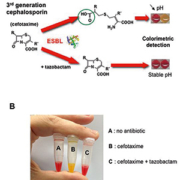
Recently, a rapid and cost-effective biochemical test was developed for the detection of ESBL producers, namely the ESBL NDP test [9]. This test is based on a technique designed to identify the hydrolysis of the β-lactam ring of a cephalosporin (cefotaxime), which generates a carboxyl group, consequently acidifying a medium [Figure 1A]. It can either be performed in a 96-well microtiter plate or into a single tube [Figure 1B]. The acidity resulting from this hydrolysis is identified by the colour change using a pH indicator. Inhibition of ESBL activity is evidenced by adding tazobactam in a complementary well [Figure 1]. The ESBL NDP test may be performed on isolate colonies or directly from clinical samples. When performed on bacterial colonies, the overall sensitivity and specificity of the ESBL NDP test are 92.6% and 100% respectively. The ESBL NDP test can easily differentiate ESBL producers from strains that are resistant to expanded-spectrum cephalosporins by other mechanisms, and from those that are likely to be susceptible to expanded-spectrum cephalosporins. Sensitivity of the test is 100% when the ESBL is of the CTX-M-type. Of note, those CTX-M ESBLs have spread worldwide and have become the most predominant type of ESBL [14]. The ESBL NDP test possesses excellent sensitivity (100%) and specificity (100%) when performed directly from blood cultures. In that case, the gain of time for detection of ESBL producers is ~48h compared to the previously mentioned techniques. Additionally, the ESBL NDP test may also be performed directly on colonies grown on selective media used for the screening of colonized patients, leading to a gain of time of at least 24h for the identification of carriers of ESBL producers and consequently faster implementation of adequate hygiene measures that will further prevent the development of nosocomial outbreaks [2, 5].
Detection of carbapenemases: Place of the Carba NP test in the diagnostic armamentarium
In Enterobacteriaceae, carbapenem resistance may be related either to association of a decrease in bacterial outer-membrane permeability with overexpression of β-lactamases possessing no carbapenemase activity, or to the expression of carbapenemases [7]. The spread of carbapenemase producers is an important clinical issue since carbapenemases confer resistance to most β-lactams. A variety of carbapenemases have been reported, such as Ambler class A carbapenemases of KPC-type, metallo-β-lactamase (Ambler class B) of VIM-, IMP- and NDM-types, and Ambler class D carbapenemase of OXA-48-type [7]. In addition, the detection of carbapenemase producers is a major issue since they are usually associated with many other non-β-lactam resistance determinants, giving rise to multi- or even pandrug-resistant isolates [1, 3].
Potential carbapenemase producers are currently screened first by susceptibility testing based on breakpoint values for carbapenems. Additional non-molecular techniques have been proposed for in vitro identification of carbapenemase production. One of the commonly used techniques corresponds to the modified Hodge test (MHT), which has been used for years. Although the addition of zinc to the culture medium was recently shown to increase the sensitivity of this test [in particular for metallo-β-lactamase (MBL) producers], the MHT remains time-consuming (at least 24h) and may lack of specificity (frequent false-positives with Enterobacter spp. overexpressing their chromosomal cephalosporinase, and false-negatives results with many NDM producers). Other detection methods based on the inhibitory properties of several molecules do exist, either for KPC (e.g. boronic acid, clavulanic acid) or MBL (e.g. EDTA, dipicolinic acid) producers, therefore allowing discrimination between the diverse types of carbapenemases. All those methods are time-consuming since they do require isolation of the bacteria from the infected samples followed by at least an additional 24h period of time for performing the inhibitor-based technique. Several molecular methods such as simplex and multiplex PCRs, DNA hybridization and sequencing are also commonly used for the identification of carbapenemase genes in research laboratories and reference centres. Recently a real-time PCR (RT-PCR) technique has been used for detecting KPC producers directly from blood cultures. Although interesting, this molecular-based technique is costly and requires expertise in molecular techniques.
A rapid and cost-effective biochemical test, the Carba NP test, was recently developed to detect carbapenemase production from isolated colonies [12]. The principle of this test is the same as that of the ESBL NDP test, but uses imipenem as substrate instead (Figure 2A). The Carba NP test differentiates carbapenemase producers (100% sensitivity and 100% specificity) from strains being carbapenem resistant due to non-carbapenemase-mediated mechanisms (Figure 2B) such as combined mechanisms of resistance (outer-membrane permeability defect associated with overproduction of cephalosporinase and/or ESBLs) or from strains that are carbapenem susceptible but express a broad-spectrum β-lactamase without carbapenemase activity (ESBL, plasmid and chromosome-encoded cephalosporinases). Interpretable positive results are always obtained in less than 1h total time, which is unique, making it possible to implement rapid containment measures to limit the spread of carbapenemase producers. The Carba NP test might be performed from colonies recovered from antibiogram (gain of time at least 24h) or from selective media used for screening of carriers (gain of time at least 48h). It was shown to detect carbapenemase producers not only in Enterobacteriaceae [11, 12] but also in Pseudomonas spp. [10]. Additionally, the Carba NP test has also been evaluated for detection of carbapenemase-producing Enterobacteriaceae directly from positive blood cultures [15]. In that case, the Carba NP test has 97.9% sensitivity and 100% specificity. This technique, once applied routinely in clinical laboratories, may guide the first line therapy for treating patients with sepsis, and therefore significantly change the patient outcomes, particularly in areas where carbapenemase producers are highly prevalent (such as Greece, Italy, Turkey, Israel, India). Additionally, when compared to molecular techniques, the Carba NP test may detect any carbapenemase production regardless of the corresponding gene being either known or unknown. Consequently, the Carba NP test is a useful tool for the detection of new carbapenemases that might eventually further disseminate, as recently shown with NDM-1 carbapenemase [8].
Conclusion
The ESBL NDP and the Carba NP tests are rapid, sensitive, specific and cost-effective biochemical tests for the early detection of the most important emerging resistance traits corresponding either to ESBL- or carbapenemase-producing Enterobacteriaceae. Implementation of such tests in the strategies of detection of multidrug-resistant bacteria may significantly improve the management and outcome of colonized and infected patients. Subsequently, the antibiotic stewardship would be improved leading to the decrease of the selective pressure that plays a crucial role in the emergence and spreading of multidrug-resistant bacteria.
Abbreviations
IMP, imipenemase; KPC, Klebsiella pneumoniae carbapenemase; NDM, New Delhi metallo-β-lactamase; VIM, Verona imipenemase; OXA, Oxacillinase
References
1. Schwaber MJ, Carmeli Y. JAMA 2008; 300: 2911–2913.
2. Spellberg B, Blaser M, et al. Clin Infect Dis 2011; 52(Suppl 5): S397–428.
3. Walsh TR, Toleman MA. J Antimicrob Chemother 2011; 67: 1–3.
4. Coque TM, Baquero F, Canton R. Euro Surveill 2008; 13.
5. Pitout JD, Laupland KB. Lancet Infect Dis 2008; 8: 159–166.
6. Poirel L, Bonnin RA, Nordmann P. Infect Genet Evol 2012; 12: 883–893.
7. Nordmann P, Dortet L, Poirel L. Trends Mol Med 2012; 18: 263–272.
8. Nordmann P, Poirel L, et al. Trends Microbiol 2011; 19: 588–595.
9. Nordmann P, Dortet L, Poirel L. J Clin Microbiol 2012; 50: 3016–3022.
10. Dortet L, Poirel L, Nordmann P. J Clin Microbiol 2012; 50: 3773–3776.
11. Dortet L, et al. Antimicrob Agents Chemother 2012; 56: 6437–6440.
12. Nordmann P, Poirel L, Dortet L. Emerg Infect Dis 2012; 18: 1503–1507.
13. Drieux L, Brossier F, et al. Clin Microbiol Infect 2008; 14(Suppl 1): 90–103.
14. Livermore DM, Canton R, et al. J Antimicrob Chemother. 2007; 59: 165–174.
15. Dortet L, Bréchard L, et al. J Antimicrob Chemother (submitted 2012).
The authors
Laurent Dortet, PhD, PharmaD, Laurent Poirel, PhD and
Patrice Nordmann, PhD, MD
Service de Bactériologie-Virologie, INSERM U914 “Emerging Resistance to Antibiotics”, Hôpital de Bicêtre, Assistance Publique/Hôpitaux de Paris, Faculté de Médecine Paris Sud, K.-Bicêtre, France
E-mail: patrice.nordmann@bct.aphp.fr
May 2026


Prins Hendrikstraat 1
5611HH Eindhoven
The Netherlands
info@clinlabint.com
PanGlobal Media is not responsible for any error or omission that might occur in the electronic display of product or company data.