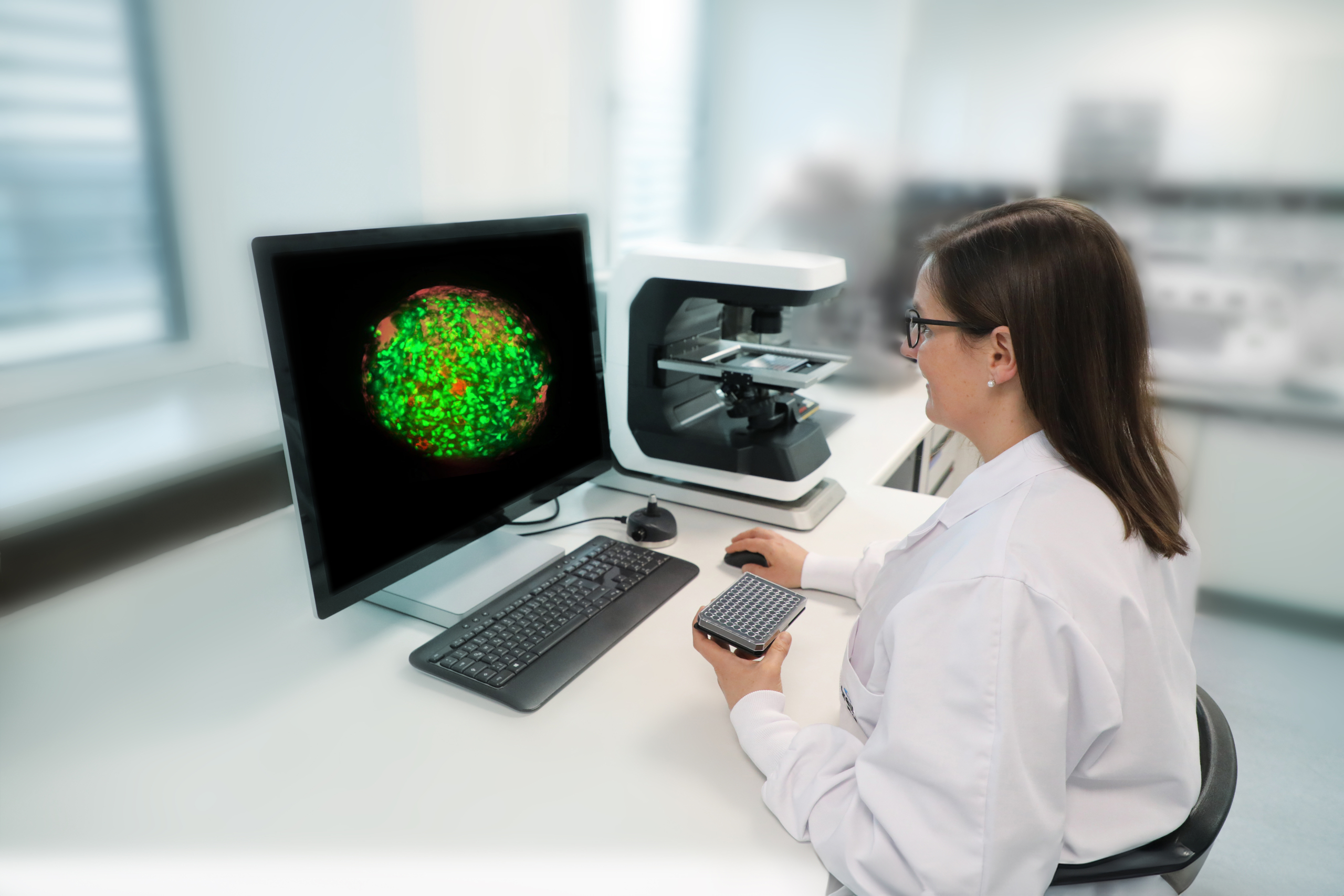


Greiner Bio-One launches spheroid plate combining 3D cell culture and high-content imaging
Greiner Bio-One is launching the SCREENSTAR Spheroid Plate, a 96-well plate for 3D cell culture applications in which individual spheroids form and are imaged at high resolution in the same plate. This removes the need to transfer spheroids for subsequent analysis. The company describes itself as one of the world’s leading providers of plastic solutions for the medical technology and life sciences industries.
Spheroid formation
The plate uses a specially engineered conical well geometry that supports the gravity-driven formation of uniform spheroids without additional hydrogels or additives. An ultra-low attachment surface prevents cell adhesion and helps preserve spheroid morphology
and function.
High-resolution imaging
For high-resolution analysis, the plate has an ultra-thin, glass-like cyclic olefin polymer (COP) film bottom with high planarity, allowing detailed imaging at magnifications of up to 100x. A size-optimised imaging window enables scan times up to ten times shorter than
with a standard 96-well plate, while the black plate design minimises unwanted crosstalk between wells.
“With the SCREENSTAR Spheroid Plate, we combine two key steps in 3D cell culture in a single workflow: reproducible spheroid formation and direct high-resolution analysis. This reduces handling steps and provides an efficient, automation-ready solution, particularly for high-content applications,” said Dr Jennifer Bischoff, product manager for 3D Cell Culture at Greiner Bio-One.
The plate is particularly suitable for 3D cell culture, drug discovery and high-content screening, and supports both manual and automated workflows.
For more information, visit: https://shorturl.at/GAFGT
Digital issue: Please click here for more information