

We have investigated the effects of three (Lepirudin, Argatroban and Bivalirudin) direct thrombin inhibitors (DTI) on routine and dedicated assays.
We found routine tests to be non-discriminative between concentrations of different DTI. The dedicated Hemoclot assay showed identical lineair increases for all three DTI.
We conclude that a dedicated calibrated assay based on a diluted thrombin time (Hemoclot) appears to be the most suitable assay for monitoring purpose.
by Dr Joyce Curvers, Dr Volkher Scharnhorst and Dr Daan van de Kerkhof
Clinical background
The use of direct thrombin inhibitors (DTIs) for prophylactic or therapeutic anticoagulation is increasing due to their predictable bioavailability, short half life and limited interaction with other medication [1-5]. The current idea is that the newer anticoagulants should not require laboratory monitoring because of these advantages. However, although monitoring of anticoagulant therapy may not be required for ‘standard’ patients, patients with an increased bleeding risk, specific co-medication (such as amiodarone or bridging therapy with coumarins), or a deviant body mass or water homeostasis (e.g. neonates, during pregnancy, the obese, the elderly, in renal insufficiency, oedema, cardiac disease) may still require occasional blood analysis. In addition when the compliance or effectiveness of the anticoagulants is doubted, measurement of the coagulation status can be crucial for the correct treatment of a patient. Since DTIs interfere with the central clotting enzyme thrombin, almost every coagulation assay is affected by its presence in blood. This also accounts for routinely used assays such as the aPTT or PT (and INR) [6].
Up to date, there is no consensus on how oral or intravenous administrable DTI should be monitored and specifically which assay should ideally be used [6,7]. In this study we performed an in vitro study in which we investigated the effect of increasing concentration levels of three DTIs: lepirudin, bivalirudin and argatroban in six plasma pools on aPTT, PT, TT and on dedicated DTI-assays (Hemoclot from Hyphen BioMed and Ecarin Clotting Time from STAGO) on a coagulation analyser (STA-R Evolution, Roche).
Materials and methods
Six different pools (N>20 samples per pool) were collected from residual plasma from patients with aPTT and PT values within reference limits (assuming that patients did not take any anticoagulant medication based on their normal aPTT and PT values).
Argatroban (Arganova, Mitsubishi Pharma, lot PF41977, 100 mg/mL) and lepirudin (Refludan, Pharmion, lot 24661611L, 50mg) were provided by the local hospital pharmacy. Bivalirudin (Angiox or angiomax, The Medicines company, lot 1574697, 250 mg) was a kind gift from the Medicines Company. All DTIs were diluted with saline (0,9% NaCl) to 5 g/L. These stock solutions were spiked into the pooled plasmas (N=6) to reach final concentrations of 1, 2, 3, 4 and 5 mg/L. Therapeutic doses of DTI are currently advised at 2 mg/L (according to package leaflet). Different plasma pools with each different concentration of different DTIs were frozen in triplicates at <-70˚C until time of measurement.
Clotting times in the aPTT, prothrombin time (PT) and thrombin time (TT) as well as the dedicated assays Hemoclot (a diluted TT) and the Ecarin Clotting Time (ECT) were recorded.
Results
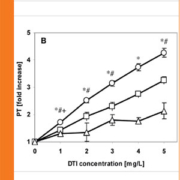
For all thrombin inhibitors investigated here, the fold increase compared to no DTI in six pools measured in routine tests (aPTT, PT and thrombin time) are shown in Figure 1. The aPTT shows a non-linear concentration-response relationship with a more gradual increase at higher DTI concentrations resulting in a limited sensitivity of the assay in this range. The concentration-response relationship for the PT was linear but with different sensitivities for the different DTIs. The low sensitivity was found especially for bivalirudin and lepuridin with respectively a maximum 2- and 3-fold increase in PT coagulation time at 5 mg/L. The thrombin time also showed a linear concentration-response relationship, with a high increase in coagulation time as function of concentration, especially for lepuridin, exceeding the maximum installed measuring range (i.e. 240 sec) of the STA-R evolution.
Figure 2 shows the data for the dedicated thrombin inhibitor tests. Similar results as for the PT were observed for the ECT, also with respect to the differences between different direct thrombin inhibitors. Lepirudin showed an increase in ratio up to 5-fold baseline value in the ECT. The increase in the Hemoclot was linear for all DTIs with similar increase as a function of concentration measured.
Conclusion
Concluding, dedicated DTI assays overcome the drawbacks of routine assays such as the PT, aPTT or TT, in which the ability to discriminate between different concentrations is insufficient. This would suggest that monitoring DTIs using the aPTT is obsolete. We have shown that dose-response curves of DTIs in dedicated assays such as the Hemoclot and ECT are acceptable. Moreover, they can be applied in a routine setting, have short turn around times and can be used to distinguish inappropriate from appropriate dosing without the necessity of reanalysis after dilution. Given that a calibrator is included in the assay kit and the test gives similar result for different DTI formulations, the Hemoclot assay appears to be the most suitable assay for monitoring purposes (apparent in this study). As more new oral thrombin inhibitors such as dabigatran etexilate find their way into troutine practice, dedicated assays may aid the clinician in better decision making concerning anticoagulant therapy, especially in certain groups of patients in need of monitoring. However, research is needed to properly determine therapeutic and prophylactic concentration ranges, with calibrated dedicated DTI assays.
Current status
The administration of (oral and) intravenous direct thrombin inhibitors is increasing, since more applications are becoming available. The pharmaceutical companies pay little attention to the fact that, in certain situations, indication of the concentration is warranted.
We are currently validating a calibrated assay based on a diluted thrombin time for use in our laboratory (and clinic), as are several other laboratories nation-wide.
Future prospects
Up to now little is known about interference of different anticoagulants combined with DTI (e.g. during bridging therapy) and the effects on the different dedicated assays. Future research will show the value of the different DTI assays in monitoring patients in order to distinguish proper dosing from under dosage or over dosage.
Moreover, standardisation and calibration of (present and new) dedicated assays for the measurement of DTI is a major issue of concern. Therefore we are currently conducting research in which a comparison of coagulation assay results with actual concentrations of the different DTI (measured with LCMSMS) is investigated.
Notification
Part of this publication is included in a manuscript that will be published in the American Journal of Clinical Pathology.
References
1. Di Nisio M, Middeldorp S, Buller HR. Direct thrombin inhibitors. N Engl J Med 2005; 353: 1028-1040.
2. Stone GW, Witzenbichler B, Guagliumi G et al. HORIZONS-AMI Trial Investigators. Bivalirudin during primary PCI in acute myocardial infarction. N Engl J Med 2008; 358: 2218-2230.
3. Mehran R, Lansky AJ, Witzenbichler B et al. HORIZONS-AMI Trial Investigators. Bivalirudin in patients undergoing primary angioplasty for acute myocardial infarction (HORIZONS-AMI): 1-year results of a randomised controlled trial. Lancet 2009; 374: 1149-1159.
4. Connolly SJ, Ezekowitz MD, Yusuf S et al. RE-LY steering committee and investigators Dabigatran versus warfarin in patients with atrial fibrillation. N Engl J Med 2009; 361: 1139-1151. Erratum in: N Engl J Med 2010 Nov 4;363(19):1877
5. Schulman S, Kearon C, Kakkar AK et al. for the RE-COVER study group. Dabigatran versus warfarin in the treatment of acute venous thromboembolism. N Engl J Med 2009; 361: 2342-2352.
6. Gosslin RC, Dager WE, King JH et al. Effect of direct thrombin inhibitors, bivalirudin, lepirudin and argatroban, on prothrombin time and INR values. Am J Clin Pathol 2004; 121: 593-599.
7. Van Ryn J, Stangier J, Haertter S et al. Dabigatran etexilate – a novel, reversible, oral direct thrombin inhibitor: interpretation of coagulation assays and reversal of anticoagulant activity. Thromb Haemost 2010; 103: 1116-1127.
The authors
Joyce Curvers PhD, Volkher Scharnhorst PhD and Daan van de Kerkhof PhD
Clinical Laboratory
Catharina Hospital Eindhoven
Eindhoven
The Netherlands
Non-invasive prenatal testing (NIPT) based on cell free fetal DNA (cffDNA) circulating in maternal blood is moving rapidly forward. With promises of improved safety, earlier detection and easier access to tests, NIPT has the potential to bring many positive benefits to prenatal care. Here we discuss the recent developments in this area.
by Dr Melissa Hill, Dr Angela Barrett, Dr Helen White and Professor Lyn Chitty
Non-invasive testing using cell free fetal DNA
Prenatal diagnosis of genetic conditions or aneuploidy has traditionally required invasive diagnostic tests [chorionic villus sampling (CVS) and amniocentesis] which carry a small but significant risk of miscarriage of around 1% and can only be safely conducted after 11 weeks in pregnancy. In 1997 Lo and colleagues identified the presence of cell free fetal DNA (cffDNA) in maternal plasma and in doing so opened the door to a safer approach to prenatal diagnosis whereby non-invasive prenatal testing (NIPT) of fetal genetic material could be performed using a maternal blood test [1].
The cffDNA is an attractive target for prenatal testing. In addition to avoiding the risk of miscarriage it is anticipated that NIPT will be available early in pregnancy as cffDNA can be detected from 4 to 5 weeks with sufficient levels for analysis by 7 to 9 weeks. The cffDNA emanates from trophoblast cells in the placenta and is pregnancy specific as it is cleared from the circulation within 30 minutes of delivery. It is now also evident that the whole fetal genome is represented in the maternal plasma, suggesting that tests for many genetic conditions will be possible [2].
The major barrier to developing specific prenatal tests based on cffDNA has been the relative concentration of the fetal material. The cffDNA represents only a small proportion (around 10%) of the cell free DNA that is present in the maternal circulation, as the vast majority is maternal in origin. As a result, it is difficult to determine what genetic information is specific to the fetus against the large background of maternal cell free DNA.
For this reason NIPT was initially limited to the identification of alleles present in the fetus but not in the mother because they were inherited from the father or because they arose de novo. These tests include fetal sex determination, which uses targets on the Y chromosome, fetal rhesus genotyping in Rhesus D (RhD) negative mothers, and paternally inherited or de novo autosomal dominant single gene disorders. All of which can be conducted using relatively straightforward molecular techniques. More recently, new technologies such as digital PCR and massively parallel sequencing (MPS) have allowed researchers to develop NIPT for single gene disorders where parents have the same mutations and for aneuploidies, both of which need to take into account the presence of the mother’s allele or chromosomes.
Early clinical successes with non-invasive testing
The two early success stories for NIPT have been fetal rhesus genotyping and fetal sex determination, which are performed using real-time quantitative PCR. Analysis of cffDNA in the plasma of RhD-negative pregnant women who have a past history of haemolytic disease of the newborn or have elevated levels of Anti-D antibodies has been used clinically to determine the fetal RHD status for almost a decade. Large scale validation studies demonstrate high specificity and sensitivity and fetal RHD typing of all RhD-negative pregnant women has the potential to become routine clinical practice in the next few years.
Similarly, NIPT for fetal sex determination is increasingly offered as standard genetic care for women with pregnancies at risk of genetic conditions that primarily affect a particular sex. Fetal sex determination informs the need for genetic diagnosis, allowing up to 50% of carriers to avoid unnecessary invasive testing, and is important for guiding pregnancy management in some conditions. The test has been shown to be reliable when performed after 7 weeks gestation [3], and clinical utility was demonstrated in a recent UK audit as only 32.9% of women subsequently underwent invasive testing [4]. Importantly for implementation, NIPT is viewed positively by women who have had the test and has been shown to be cost neutral compared to invasive testing, which means women can have the clinical benefits of the test at no extra cost to health services [4].
NIPT for single gene disorders
The first use of cffDNA for the diagnosis of a single gene disorder was for the autosomal dominant condition myotonic dystrophy [5]. NIPT has also been possible for other paternally inherited autosomal dominant disorders such as early onset primary dystonia and Huntington’s disease. NIPT for the autosomal dominant condition achondroplasia, which commonly occurs as a de novo mutation, has also been successful. NIPT for autosomal recessive or maternally transmitted autosomal dominant disorders is more difficult due to the need to distinguish between the maternal and fetal free DNA. Exclusion of the paternal mutation is possible in autosomal recessive conditions where the parents carry different mutations. If the paternal allele is detected, there is a 50% risk that the fetus will inherit the disorder, and invasive testing would be recommended. If the paternal allele is not detected invasive testing is not required.
It is now clear that NIPT can be successfully applied to recessive conditions where parents carry the same mutation using digital PCR, which allows high copy number counting and quantification of alleles. Digital PCR requires the dilution of template DNA to an average concentration of less than one molecule per well, and hundreds to thousands of replicates of a PCR reaction are analysed. The mutation status of the fetus is predicted with an approach known as relative mutation dosage (RMD), which is based on the premise that if both the woman and the fetus are heterozygous there will be an allelic balance between the wild type and normal alleles; if the fetus is homozygous for either the mutant or the wild type allele there will be an over-representation of one or the other [6]. Another approach to identify single gene disorders non-invasively that we may see more of in the future is MPS, which has been used to determine the inheritance of two different β-thalassemia alleles [2].
NIPT for aneuploidies
Prenatal screening and diagnosis for fetal aneuploidy is offered routinely to all pregnant women in many countries to detect trisomy 21 (Down’s syndrome), trisomy 18 (Edwards syndrome) and trisomy 13 (Patau syndrome). The extensive scale of current prenatal screening programmes for these conditions means that success in developing accurate NIPT for aneuploidies will transform antenatal care. Several approaches have been explored including fetal specific epigenetic markers and SNP based methods. The most promising approach to date utilises MPS, which allows large scale single molecule counting to detect the increase in the number of sequences that result from the trisomic chromosome.
The first successful proof-of-principle studies utilising MPS to detect fetal aneuploidy from maternal plasma were published in 2008 [7,8]. Using this methodology, millions of short DNA sequences are generated from genomic locations. The sequences are then compared with the known human genome sequence, to establish how many sequences have been derived from each chromosome. For example, by comparing the total number of uniquely mapped chromosome 21 sequences obtained from a cfDNA sample with the number obtained from a normal genomic DNA sample, very small increases in the amount of chromosome 21 can be detected in the cfDNA sample if the fetus carries an additional chromosome 21.
Several large scale validation studies have subsequently demonstrated high levels of sensitivity (100%) and specificity (98–99%) using MPS. Efforts to decrease costs and increase throughput have seen many groups use multiplexing of patient samples into samples libraries that are run on one lane of the sequencing platform (2–12 patients per lane). Another strategy to decrease costs has been the use of targeted or ‘chromosome-selective’ MPS approaches where the sequencing assay is targeted to non-polymorphic loci on specific chromosomes such as 18 and 21 [10]. Studies with targeted MPS also show the potential for greater accuracy with the use of a novel bioinformatic algorithim (FORTE) that considers the proportion of specific cffDNA in the samples and accounts for the prior risk of trisomy (taken from published data on maternal and fetal gestational age related risks) to predict the likelihood of fetal trisomy for each patient [9].
Following the success of the validation studies, NIPT for aneuploidy is being offered through commercial providers in some countries (Sequenom, BGI, Berry Genomics, Aria, LifeCodexx). It is not yet clear, however, how these new tests will be introduced more widely into antenatal care. At present the small false positive rate means that the test is considered an “advanced screening test” that should be confirmed by invasive testing. Other considerations for implementation include the cost of the technology, the gestational limits of the test and the structure of existing screening programmes. All of these factors will impact on whether NIPT is introduced as a replacement for invasive testing or as an adjunct to current screening tests offered to all women.
Conclusions
NIPT is rapidly bringing about dramatic changes to antenatal care. Fetal sex determination and RhD genotyping are now available as clinical services in a number of countries. Testing is already possible for some single gene disorders, and new technologies such as digital PCR and MPS are allowing the challenges of testing for recessive conditions and aneuploidies to be met. Successful implementation, however, will require more than the development of laboratory tests and we must consider ethical issues, research stakeholder views and assess implementation strategies to ensure NIPT is offered in a way that best meets women’s needs. For this reason studies such as the RAPID programme in the UK (www.rapid.nhs.uk) that look at all aspects of test development and implementation are important.
Notification
This article summarises a recent review published in Best Practice in Clinical and Obstetric Gynaecology: Hill M, Barrett AN, White H, Chitty LS. Uses of cell free fetal DNA in maternal circulation. Best Pract Res Clin Obstet Gynaecol. 2012 Apr 27 [Epub ahead of print].
References
1. Lo YM, Corbetta N, Chamberlain PF, et al. Presence of fetal DNA in maternal plasma and serum. Lancet. 1997; 350: 485–487.
2. Lo Y, Chan K, Sun H, et al. Maternal plasma DNA sequencing reveals the genome-wide genetic and mutational profile of the fetus. Sci Transl Med. 2010; 2: 61ra91.
3. Devaney SA, Palomaki GE, Scott JA, et al. Noninvasive fetal sex determination using cell-free fetal DNA: a systematic review and meta-analysis. JAMA. 2011; 306: 627–636.
4. Hill M, Lewis C, Jenkins L, Allen S, Elles R, Chitty LS. Implementing non-invasive prenatal fetal sex determination using cell free fetal DNA in the United Kingdom. Expet Opin Biol Ther. 2012; Suppl 1: S119–126.
5. Amicucci P, Gennarelli M, Novelli G, et al. Prenatal diagnosis of myotonic dystrophy using fetal DNA obtained from maternal plasma. Clin Chem. 2000; 46: 301–302.
6. Lun FM, Tsui NB, Chan KC, et al. Noninvasive prenatal diagnosis of monogenic diseases by digital size selection and relative mutation dosage on DNA in maternal plasma. Proc Natl Acad Sci U S A. 2008; 105: 19920–19925.
7. Fan HC, Blumenfeld YJ, Chitkara U, et al. Noninvasive diagnosis of fetal aneuploidy by shotgun sequencing DNA from maternal blood. Proc Natl Acad Sci U S A. 2008; 105: 16266–16271.
8. Chiu RW, Chan KC, Gao Y, et al. Noninvasive prenatal diagnosis of fetal chromosomal aneuploidy by massively parallel genomic sequencing of DNA in maternal plasma. Proc Natl Acad Sci U S A. 2008; 105: 20458–20463.
9. Sparks AB, Struble CA, Wang ET, et al. Optimized Non-invasive evaluation of fetal aneuploidy risk using cell-free DNA from maternal blood. Am J Obstet Gynecol. 2012; 206: 319.
The authors
Melissa Hill PhD1, Angela Barrett PhD1,
Lyn Chitty MRCOG, PhD1* and
Helen White PhD2
1 Clinical and Molecular Genetics Unit, UCL Institute of Child Health and Great Ormond Street Hospital for Children NHS Foundation Trust, London, UK
2 National Genetics Reference Laboratory (Wessex), Salisbury District Hospital, Salisbury, UK
*Corresponding author
e-mail: l.chitty@ucl.ac.uk



Together with HIV/AIDS and TB, malaria is one of the major public health challenges of the developing world. Prompt diagnosis is a priority. Rapid diagnostic tests are readily available, quick to yield results and can be effectively used in resource-limited settings.
by Meghna Patel
Malaria is a tropical disease caused by parasites of the genus Plasmodium and transmitted by Anopheles mosquitoes. Being endemic in more than 100 countries, half the world’s population is at risk for malaria. Children are at particular risk, accounting for most malaria deaths globally [1]. Each year roughly 250 million people are infected and nearly a million people die from the disease [2]. Malaria causes significant morbidity and mortality, particularly in resource-poor regions. Sub-Saharan Africa is the hardest hit region in the world and parts of Asia and Latin America also face significant malaria epidemics [3]. Four major species of malarial parasite infect humans: Plasmodium falciparum, P. vivax, P. ovale and P. malariae. The first two species cause the most infections worldwide. On the continent of Africa, P. falciparum malaria predominates, whereas in parts of Asia and Latin America, P. vivax is more prevalent. Two other species, P. ovale and P. malariae, are also capable of causing human disease. A fifth species, Plasmodium knowlesi, is found in Southeast Asia; it mainly causes malaria in simians but it can also infect humans.
Since malaria is preventable and treatable, such high incidences point to inappropriate management of the condition in some cases, with incorrect or inefficient diagnosis and/or treatment. Rapid and accurate diagnosis of malaria before treatment is essential for effective and timely treatment of patients and to minimise the spread of drug resistance and thus the requirement of more expensive drugs, frequently unaffordable for resource-poor countries [4]. This review discusses the currently available techniques for malaria diagnosis
focusing on rapid diagnostic tests (RDT).
Diagnosis
As in other pathological conditions malarial diagnosis is based on clinical investigations and pathological laboratory analysis. Diagnosis based on clinical symptoms is the least expensive, most commonly used method in resource poor conditions. However, the overlapping of malaria symptoms with other tropical diseases impairs its specificity and therefore encourages the indiscriminate use of anti-malarials for managing febrile conditions in endemic areas.
Laboratory diagnosis of malaria includes identifying malarial parasites or their antigens/products in patient blood. Although this may seem simple, diagnostic efficacy depends on various factors such as stage and forms of the various malarial species, endemicity of different species, density of parasitaemia etc.
In the laboratory, malaria is diagnosed using different techniques e.g. conventional microscopic diagnosis by examining stained thin and thick peripheral blood smears, other concentration techniques, e.g. quantitative buffy coat (QBC), rapid diagnostic tests and molecular diagnostic methods, such as PCR. The pros and cons of these methods have also been described, chiefly related to sensitivity, specificity, accuracy, precision, time consumed, cost-effectiveness, labour intensiveness, the need for skilled microscopists etc.
Malaria is conventionally diagnosed by microscopic examination of stained blood films using Giemsa, Wright’s or Field’s stains [5]. Even though microscopic examination is considered to be the gold standard method, the most important limitation is its relatively low sensitivity, thus the generation of false negative results, particulary when microscopy is carried out using a low quality microscope and/or by less experienced personnel, and with low parasitaemias as in asymptomatic malaria. Furthermore the technique is laborious and not really suitable for remote rural settings, with no electricity or health facility resources.
The QBC technique was designed to enhance microscopic detection of malaria parasites [6]. This technique utilises micro-haematocrit tubes, fluorescent dyes and an appropriate fluorescence microscope for detection. Although simple, reliable and user-friendly, QBC is not widely applicable as it is costly, requires specialised instrumentation and is far from ideal for determining species and numbers of parasites.
Serological methods to diagnose malaria usually target antibodies against asexual blood stage malarial parasites. Immunofluorescence antibody testing (IFA) has proved a reliable serological test for malaria [7]. Although IFA is sensitive and specific, it is time-consuming and subjective. Furthermore the reliability greatly depends on the use of standardised reagents, in turn dependent on the expertise of laboratory workers.
Recent developments in malaria diagnosis suggest the use of PCR-based techniques. These techniques have proven to be one of the most specific and sensitive diagnostic methods, especially in malaria cases with low parasitaemia or mixed infections [8]. PCR was found to be more sensitive than QBC and some RDTs [9,10]. Compared with the gold standard method for malaria diagnosis, PCR has exhibited higher sensitivity and specificity [8]. Moreover, PCR can also help detect drug-resistant parasites, and is compatible with automation so that large numbers of samples can be processed. Some modified PCR methods e.g., nested PCR, real-time PCR and reverse transcription PCR are reliable and appear to be useful second-line techniques. Although PCR appears to offer the paramount sensitivity and specificity, its adoption in labs is limited due to the complex methodology, high cost and the demand for specialised instruments, the complex quality control and the difficulty of recruiting trained technicians especially in resource-poor conditions.
As the majority of malaria cases are found in countries where cost-effectiveness is an especially important factor and the ease of diagnostic test performance and training of personnel are also major considerations, new technology has given due attention to these points and utilised techniques that comply with diagnostic need without being very demanding. This has mainly resulted in the
development of RDTs.
Rapid diagnostic tests
RDT are largely based on the principle of immunochromatograpy, in which either monoclonal or polyclonal antibodies against the parasite antigen are immobilised to capture the parasite antigens from the peripheral blood. Currently, immunochromatographic tests target the histidine-rich protein-II of P. falciparum, a pan-malarial Plasmodium aldolase and the parasite-specific
lactate dehydrogenase.
Histidine-rich protein II of P. falciparum (PfHRP-II) is a water soluble protein that is produced by the asexual stages and young gametocytes of P. falciparum. It is abundantly expressed on the red cell membrane surface [11].
Parasite lactate dehydrogenase (pLDH) is a soluble glycolytic enzyme produced by the asexual and sexual stages of the live malarial parasites [9]. It is present in and released from the parasite-infected erythrocytes. It has been found in all four major species causing malaria in humans as their respective isoforms.
Plasmodium aldolase is an enzyme of the glycolytic pathway expressed by sexual and asexual stages of malaria parasites. RDTs have been developed in different test formats such as dipstick, card, well and cassette. The test procedure varies between different test kits. In general, the blood sample is mixed with a buffer solution that contains a haemolysing compound and a specific antibody that is labelled with a visually detectable marker such as colloidal gold. If the target antigen is present in the blood, a labelled antigen-antibody complex is formed and it migrates forward in the test strip and is captured at the test line. It is essential to include a control line to check on test validity. A washing buffer is then added to clear the background for easy
visualisation of the coloured lines.
RDTs are available in kit form with all the necessary reagents so they can be utilised even in remote places by less skilled personnel to generate results within a short period of time, usually within 15-20 minutes.
WHO recommended a few desirable characteristics for RDTs regarding their accuracy and sensitivity (WHO/MAL/2000.1091). According to this RDTs should be at least as accurate as results derived from microscopy performed by an average technician under routine field conditions, the sensitivity should be above 95% compared to microscopy, and the detection of parasitaemia should be such that levels of 100 parasites /µL (0.002% parasitaemia) should be detected reliably with a sensitivity of 100%. One product received U.S. FDA clearance in June 2007.
Today most RDTs have achieved this goal for P. falciparum, but not for other species. Roughly, RDT sensitivity declines at parasite densities < 500/µL blood for P. falciparum and < 5,000/µL blood for P. vivax [12]. RDT consumption, especially in developing countries, has increased over the past few years.
SPAN diagnostics offers RDTs i.e. ParaHIT-Total and ParaHIT-f in both dip stick, as well as in device format, for rapid and reliable diagnosis of malaria. ParaHIT-f is intended to diagnose malaria caused by P. falciparum with the use of P. falciparum specific HRP-II, wheareas ParaHIT-Total explores HRP-II and pan malarial species specific aldolase, as separate lines to screen malaria and for
differential determination of P. falciparum.
References
1. WHO, World Malaria Report 2010; December 2010.
2. WHO 10 facts on malaria
3. CDC, Malaria
4. Barnish G et al. Newer drug combinations for malaria. BMJ 2004; 328: 1511–1512
5. Warhurst DC et al. Laboratory diagnosis of malaria. J Clin Pathol 1996; 49: 533-538
6. Clendennen TE 3rd et al. QBC and Giemsa stained thick blood films: diagnostic performance of laboratory technologists. Trans R Soc Trop Med Hyg 1995; 89: 183-184
7. She RC et al. Comparison of immune fluorescence antibody testing and two enzyme immunoassays in the serologic diagnosis of malaria. J Travel Med 2007; 14: 105-111
8. Morassin B et al. One year’s experience with the polymerase chain reaction as a routine method for the diagnosis of imported malaria. Am J Trop Med Hyg 2002; 66: 503- 508
9. Makler MT et al. A review of practical techniques for the diagnosis of malaria. Ann Trop Med Parasitol 1998; 92: 419-433
10. Rakotonirina H et al. Accuracy and reliability of malaria diagnostic techniques for guiding febrile outpatient treatment in malaria-endemic countries. Am J Trop Med Hyg 2008; 78: 217-221
11. Rock EP et al. Comparative analysis of the Plasmodium falciparum histidine-rich proteins HRP1, HRP2 and HRP3 in malaria diagnosis of diverse origin. Parasitology 1987; 95: 209–227.
12. Wongsrichanalai C et al. A Review of Malaria Diagnostic Tools: Microscopy and Rapid Diagnostic Test (RDT). Am J Trop Med Hyg 2007; 77: 119–12.
The author
Meghna Patel
SPAN Diagnostics Ltd
Udhna, Surat, India


There are a huge number of peer-reviewed papers covering sepsis, and it is frequently difficult for healthcare professionals to keep up with the literature. As a special service to our readers, CLI presents a few key abstracts from the clinical and scientific literature chosen by our editorial board as being particularly worthy of attention.
Predictors of survival in sepsis: what is the best inflammatory marker to measure?
Beyond the widely used acute-phase proteins C-reactive protein (CRP) and procalcitonin (PCT) in sepsis manegement, many new molecules have been studied deriving from different organs or cells affected, due to the systemic nature of sepsis. Cytokines, coagulation factors/characteristics, vasoactive hormones and several others have recently proved to be relevant in sepsis syndrome and probably useful for outcome prediction. However, single time point measurements may be less predictive than consideration of the time-dependent course of parameters. Many biomarkers display relevant correlation with the clinical outcome of patients with severe sepsis and septic shock. Consideration of their time courses may be more reliable than absolute levels. Clinical decision should not only be based on biomarkers but organ dysfunctions, for example, should also be taken into account.
Cytokine profiles of preterm neonates with fungal and bacterial sepsis
Information on cytokine profiles in fungal sepsis (FS), an important cause of mortality in extremely low birthweight infants (ELBW), is lacking. The authors hypothesised that cytokine profiles in the 1st 21 days of life in ELBW with FS differ from those with bacterial sepsis (BS) or no sepsis (NS). In a secondary analyses of the NICHD Cytokine study, three groups were defined – FS (≥1 episode of FS), BS (≥1 episode of BS without FS) and NS. Association between 11 cytokines assayed in dried blood spots obtained on days 0-1, 3±1, 7±2, 14±3, and 21±3 and sepsis group was explored.Of 1066 infants, 89 had FS and 368 had BS. Compared to BS, FS was more likely to be associated with lower birthweight, vaginal delivery, patent ductus arteriosus, postnatal steroids, multiple central lines, longer respiratory support and hospital stay, and higher mortality (p<0.05). Analyses controlling for covariates showed significant group differences over time for IFN-γ, IL-10, IL-18, TGF-β and TNF-α (p<0.05). These differences, which may have implications for diagnosis and treatment, require validation in rigorously designed prospective studies.
Prognostic value of proadrenomedullin in severe sepsis and septic shock patients with community-acquired pneumonia
Midregional proadrenomedullin (proADM) is a novel biomarker with potential prognostic utility in patients with community-acquired pneumonia. The aim of this study was to investigate the value of proADM levels for severity assessment and outcome prediction in severe sepsis and septic shock due to CAP. The prospective observational study included 49 patients admitted to ICU with both a clinical and radiologic diagnosis of pneumonia and fulfilling criteria for severe sepsis or septic shock. The prognostic accuracy of proADM levels was compared with those of pneumonia severity index and of procalcitonin (PCT) and C-reactive protein (CRP). Forty-nine patients with severe sepsis or septic shock due to CAP were included in the study. Mortality was 24.5% for ICU and 34.7% for hospital mortality. In all cases proADM values at ICU admission were pathological (considering normal proADM levels <4 nmol/L). ProADM consistently rose as PSI class advanced from II to V (p = 0.02). Median proADM levels were higher (p <0.01) in hospital non-survivors 5.0 (1.9-10.1) nmol/L vs. survivors 1.7 (1.3-3.1) nmol/L. These differences were also significant with respect to ICU mortality. The receiver-operating characteristic curve for proADM yielded an AUC of 0.72; better than the AUC for PCT and CRP (0.40 and 0.44 respectively) and similar to PSI (0.74). In this study MR-proADM levels correlated with increasing severity of illness and death. High MR-proADM levels thus offer additional risk stratification in high-risk CAP patients.
As with much else in healthcare, change is the driver of clinical lab technologies today. Rapid advances in genetics, especially the game-changing promise of biomarkers and personalized medicine, have dramatically extended the traditional spectrum of clinical lab technologies. A snapshot of the specialties within a modern clinical lab and the key drivers of change within each is provided below.
Blood banking: Over the past decade, automation has halved serological testing times. Nevertheless, enduring safety concerns have led to new technologies such as CAT (Column Agglutination), along with remote, real-time and secure monitoring of equipment by technical service providers.
Clinical chemistry and microbiology: The choice and sequencing of chromatography, mass spectrometry, electrophoresis, thermocycling or radioisotopes have become quicker and more reliable due to the widespread use of testing protocols. New tools for microbiologists include phosphoimaging and fluorescence activated cell sorters. One of the most promising fields at present consist of new DNA-based techniques.
Cytotechnology: Still focused largely on cancers, cytotechnology has expanded its scope from diagnosis to prognosis. The key drivers here are molecular diagnostics and FISH (fluorescence in situ hybridization), with data warehousing support for tissue correlation. FISH is used to track specific DNA sequences on chromosomes, by using probes which bind only with specific fragments of the chromosome; these are then identified by fluorescence microscopes. FISH has proved to be indispensable in diagnosing rare diseases such as Cri-du-chat, certain kinds of childhood leukemias, as well as syndromes like Prader-Willi and Angelman.
Histotechnology: Traditionally associated with cutting and staining tissue specimens for the study of diseases at a microscopic level, histotechnicians are now branching out into one of the fastest growing areas of clinical lab technology, namely immunohistochemistry. This is the localization of antigens via the use of labelled antibodies, with antigen-antibody interactions subsequently visualized by markers. The 1950s era technology of using fluorescent dye was followed by enzyme labelling in the 1960s and 1970s (respectively peroxidase and phosphatase). Colloidal gold permitted electron microscopes to be deployed for multi-level staining, since gold particles can be manufactured in a vast range of sizes. Other techniques include autoradiography, using radioactive elements as labels for visualizing immunoreactions.
Immunology: Rather than the painstaking, bottom-up process of examining individual cells under a microscope, immunology is now becoming top-down. Fuelled by the Human Genome Project, studies of tissues and organs and the molecular pathways of the immune system have led to a host of new waypoints in mapping the progress of a disease (e.g signal transduction mechanisms), along with innovative tools such as custom-built peptide probes, supermagnetic nanobeads, hybridomas, epitopes and tetramer assays, in brief – the new science of proteomics.
Molecular biology: Automated cell counting equipment and ultra-sophisticated electron microscopes have buttressed the arsenal of tools to conduct protein and nucleic acid tests, above all the identification of anomalies and abnormalities. Precision remains a key driver in a field where a margin of 1/1,000 can be a serious error, and destroy the integrity of a unique sample. Another enduring concern is sterility, especially RNAse contamination.
May 2026

Prins Hendrikstraat 1
5611HH Eindhoven
The Netherlands
info@clinlabint.com
PanGlobal Media is not responsible for any error or omission that might occur in the electronic display of product or company data.