

To reduce the window period for HIV-1 infection, a method for detecting trace amounts of HIV-1 p24 in blood is needed. We developed a simple de novo ultrasensitive colorimetric ELISA by adding a thio-NAD cycling solution to the standard ELISA. The limit of detection for p24 was 0.005 IU (i.e. attomoles) per assay by the ultrasensitive colorimetric ELISA.
by Dr A. Nakatsuma, M. Kaneda, H. Kodama, M. Morikawa, S. Watabe, et al.
Background
During the window period between infection with human immunodeficiency virus type 1 (HIV-1) and the appearance of detectable antibodies to HIV-1, the infection cannot be diagnosed. Attempts to shorten this period have been made using a fourth-generation immunoassay that detects both HIV-1/2 IgG/M and HIV-1 p24 antigens [1]. However, most of the commercially available detection systems for fourth-generation immunoassays use chemiluminescent measurement and thus require specialized, highly expensive automated measurement equipment. For this reason, fourth-generation immunoassays are performed only at diagnostics companies and hub hospitals. To overcome this limitation and to test many samples simultaneously, there is need of an immunoassay with increased sensitivity for the HIV-1 p24 antigen that nonetheless uses a common enzyme and does not require any specialized instruments.
In 2010, French health authorities mandated a limit of detection of at least 2 IU/mL of HIV-1 p24 antigen for a Conformité Européenne (CE)-marked HIV antigen/antibody assay [2]. According to this mandate, commercially available assay kits were manufactured to detect p24 antigen with limits of detection ranging from 0.505 to 1.901 IU/mL and from 11.9 to 33.5 pg/mL [2]. Units of pg/mL are used for the Société Française de Tranfusion Sanguine (SFTS) standard (i.e. recombinant proteins), versus IU/mL for the WHO (World Health Organization) standard. As 1 IU/mL is estimated to be equivalent to 10 pg/mL and MW = 24 000 for p24, the best sensitivity in these kits is 0.505 IU/mL, which is ~2 × 10⁻¹⁶ moles/mL.
To date, numerous methods have been proposed for the detection of p24 antigen. However, the limit of detection of p24 antigen is not expected to overcome the sensitivity of 10−17 to 10−18 moles/mL. In addition, we have to note that HIV testing of many samples requires not only ultrasensitive HIV-1 p24 detection but also rapidity, a reasonable cost, and a simple protocol without the requirement of special equipment. In the present review, we introduce a de novo ultrasensitive colorimetric enzyme-linked immunosorbent assay (ELISA) for HIV-1 p24 [3].
Mechanism of ultrasensitive colorimetric ELISA
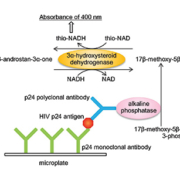
Watabe and colleagues developed an ultrasensitive ELISA to measure trace amounts of proteins by combining a conventional ELISA with thionicotinamide-adenine dinucleotide (thio-NAD) cycling [4]. Their rationale was that although proteins cannot be amplified by polymerase chain reaction (PCR) in the manner of nucleic acids, a detectable signal for proteins can be amplified. Thus, their ultrasensitive ELISA (Fig. 1) employs a sandwich method using a primary and a secondary antibody for antigens. An androsterone derivative, 3α-hydroxysteroid, is produced by the hydrolysis of 3α-hydroxysteroid 3-phosphate with alkaline phosphatase linked to the secondary antibody. This 3α-hydroxysteroid is oxidized to a 3-ketosteroid by 3α-hydroxysteroid dehydrogenase (3αHSD) with a cofactor thio-NAD. By the opposite reaction, the 3-ketosteroid is reduced to a 3α-hydroxysteroid by 3α-HSD with a cofactor NADH. During this cycling reaction, thio-NADH accumulates in a quadratic function-like fashion. Accumulated thio-NADH can be measured directly at an absorbance of 400 nm without any interference from other cofactors.
This method enables the detection of a target protein with ultrasensitivity (10−19 moles/assay) by measuring the cumulative quantity of thio-NADH by a colorimetric method without the use of any special instruments for the measurements of fluorescence, luminescence or radio isotopes [4]. Further, we should note that this ultrasensitive method will allow a technician to detect trace amounts of proteins simply by applying thio-NAD cycling reagents to the conventional ELISA system. We therefore applied this ultrasensitive ELISA to the detection of HIV-1 p24 antigen in blood [3].
Sensitivity and stability of the ultrasensitive colorimetric ELISA for HIV-1 p24
A typical linear calibration curve for HIV-1 p24 antigen provided by the ultrasensitive ELISA coupled with thio-NAD cycling was y = 0.27x + 0.019, R2 = 0.99 in the range of 0.1‒1.0 IU/mL. The limit of detection of p24 was 0.0055 IU/assay (i.e. ~2 × 10⁻¹⁸ moles/assay). These findings indicate that the ultrasensitive colorimetric ELISA succeeds in detecting p24 at the attomole level [3]. Because this measurement system employs a 50 µL solution for each assay, the detection limit corresponded to 0.1 IU/mL, or 10−17 moles/mL. Therefore, even in terms of the concentration per mL, our detection limit is less than one-tenth of that required by the French health authorities [2]. The coefficient of variation was 8% for 1 IU/mL.
Spike-and-recovery test using serum
We attempted to perform spike-and-recovery tests in which the HIV-1 p24 antigen was added to the control serum. Because our results demonstrated that the ratio was about 100% for 0.5 IU/mL of HIV-1 p24, which was less than the value (2 IU/mL) required for a CE-marked HIV antigen/antibody assay (see Background), the ultrasensitive method was judged to sufficiently detect IV-1 p24 antigen in human blood obtained from patients in the very early period after infection.
Detection of HIV-1 p24 in the early stages of infection
It is important to diagnose primary HIV-1 infection and begin antiretroviral treatment as early as possible. Most HIV-1/2 antibody diagnostic tests detect the antibodies for the antigens of HIV-1 gp41 and HIV-2 gp36, which are highly conservative transmembrane proteins. These tests are quick and easy, and thus have been widely used in many clinics and public health centres. However, when only the antibody diagnostic tests are used, there is a long delay (generally a 28-day window period) before diagnosis is possible [5]. Further, HIV-1/2 antibody tests in children younger than 18 months tend to be especially inaccurate as a result of the continued presence of maternal antibodies [6]. To shorten the delay and to validate HIV tests, the HIV-1 p24 antigen, the concentration of which is expected to increase before antibodies emerge, should be detectable in trace amounts. HIV-1 p24 in blood emerges transiently in the very early period after infection, and then its concentration quickly returns to the basal level [5]. An HIV-1 p24 test is, therefore, very useful as a screening test in the early stage of infection.
Closing the gap on PCR-based nucleic acid testing (NAT)
Generally, the gold standard for diagnosing HIV-1 is PCR-based nucleic acid testing (NAT) [7], but this method is expensive and has infrastructure requirements, a long measuring time, and high complexity, thereby limiting its usefulness for large numbers of samples. There is also the issue that much of the world lacks access to reliable NAT, and thus in many geographic regions the policy is to simply wait until symptoms develop. Use of ultrasensitive detection of HIV-1 p24 antigen for early diagnosis would be a simple and reasonable alternative to NAT, such as for monitoring HIV treatment and protecting the blood supply. Accordingly, it is time to reconsider whether NAT should be the gold standard for diagnosing HIV-1. Barletta et al. claimed that the target protein (i.e. HIV-1 p24 antigen) is present in the virion in much higher numbers than viral RNA copies (approximately 3000 HIV-1 p24 antigen molecules versus 2 RNA copies per virion) [8]. The 10−18 moles/assay value in our present results corresponds to 106 protein molecules/assay, or ~103 RNA copies/assay. Although under laboratory conditions a real-time PCR (i.e. NAT) can detect on the order of 101 RNA copies/assay, the limitation of detection is usually in the order of 102 RNA copies/assay [9]. Hence, the ultrasensitive ELISA coupled with thio-NAD cycling for HIV-1 p24 is closing in on the detection limit obtained by NAT, with a margin of difference of only one order of magnitude.
Conclusion
The ultrasensitive ELISA coupled with thio-NAD cycling is a very convenient method for the early testing of HIV-1 infection because it requires only the addition of a thio-NAD cycling solution to the usual ELISA without the use of any specialized measuring equipment. Consequently, the present method could be widely used as a powerful tool to test many samples simultaneously.
References
1. George CRR, Robertson PW, Lusk MJ, Whybin R, Rawlinson W. Prolonged second diagnostic window for human immunodeficiency virus type 1 in a fourth-generation immunoassay: Are alternative testing strategies required? J Clin Microbiol. 2014; 52: 4105–4108.
2. Ly TD, Plantier JC, Leballais L, Gonzalo S, Lemée V, Laperche S. The variable sensitivity of HIV Ag/Ab combination assays in the detection of p24Ag according to genotype could compromise the diagnosis of early HIV infection. J Clin Virol. 2012; 55: 121–127.
3. Nakatsuma A, Kaneda M, Kodama H, Morikawa M, Watabe S, Nakaishi K, Yamashita M, Yoshimura T, Miura T, Ninomiya M, Ito E. Detection of HIV-1 p24 at attomole level by ultrasensitive ELISA with thio-NAD cycling. PLoS One 2015; 10: e0131319.
4. Watabe S, Kodama H, Kaneda M, Morikawa M, Nakaishi K, Yoshimura T. Ultrasensitive enzyme-linked immunosorbent assay (ELISA) of proteins by combination with the thio-NAD cycling method. BIOPHYSICS. 2014; 10: 49–54.
5. World Health Organization (WHO). HIV/AIDS Fact sheet No 360. WHO 2015; http://www.who.int/mediacentre/factsheets/fs360/en/
6. Zijenah LS, Tobaiwa O, Rusakaniko S, Nathoo KJ, Nhembe M, Matibe P, Katzenstein DA. Signal-boosted qualitative ultrasensitive p24 antigen assay for diagnosis of subtype C HIV-1 infection in infants under the age of 2 years. J Acquir Immune Defic Syndr. 2005; 39: 391–394.
7. Patel P, Mackellar D, Simmons P, Uniyal A, Gallagher K, Bennett B, Sullivan TJ, Kowalski A, Parker MM, LaLota M, Kerndt P, Sullivan PS; Centers for Disease Control and Prevention Acute HIV Infection Study Group. Detecting acute human immunodeficiency virus infection using 3 different screening immunoassays and nucleic acid amplification testing for human immunodeficiency virus RNA, 2006-2008. Arch Intern Med. 2010; 170: 66–74.
8. Barletta JM, Edelman DC, Constantine NT. Lowering the detection limits of HIV-1 viral load using real-time immuno-PCR for HIV-1 p24 antigen. Am J Clin Pathol. 2004; 122: 20–27.
9. Wagatsuma A, Sadamoto H, Kitahashi T, Lukowiak K, Urano A, Ito E. Determination of the exact copy numbers of particular mRNAs in a single cell by quantitative real-time RT-PCR. J Exp Biol. 2005; 208: 2389–2398.
The authors
Akira Nakatsuma1 PhD, PhC; Mugiho Kaneda1 BAgr; Hiromi Kodama1 MAgr; Mika Morikawa1,2 BASc; Satoshi Watabe3 BPha; Kazunari Nakaishi2; Masakane Yamashita4 PhD; Teruki Yoshimura5 PhD, PhC; Toshiaki Miura6 PhD, PhC; Masaki Ninomiya1 PhD, PhC; Etsuro Ito*1 PhD
1 Kagawa School of Pharmaceutical Sciences, Tokushima Bunri University, Sanuki, Japan
2 TAUNS Laboratories, Inc., Izunokuni, Japan
3 BL Co., Ltd., Numazu, Japan
4 Faculty of Science, Hokkaido University, Sapporo, Japan
5 Faculty of Pharmaceutical Sciences, Health Sciences University of Hokkaido, Ishikari-Tobetsu, Japan
6 Graduate School of Pharmaceutical Sciences, Hokkaido University, Sapporo, Japan
*Corresponding author
E-mail: eito@kph.bunri-u.ac.jp
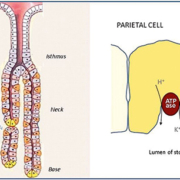
by Dr Petraki Munujos The anti-parietal cell antibodies show one of the most distinctive fluorescent patterns in the autoantibody screening by indirect immunofluorescence. Although these antibodies react with a well known target antigen (H+/K+ ATPase) solely present in the parietal cells of the gastric gland, the use of combined tissue sections in the same reaction […]


Mass spectrometry-based methods hold great promise for addressing protein heterogeneity. As a result of post-translational processing, proteins can exist in vivo as multiple proteoforms. The added information contained in the protein profile can be important in physiological and pathological states. Presented here is an overview of a mass spectrometric immunoassay (MSIA) for quantitative determination of the chemokine RANTES proteoforms. MSIA offers protein quantification and profiling in a high-throughput and time-efficient manner. Across a cohort of ~300 human plasma samples, a total of 11 different RANTES proteoforms were quantified in less than 3 hours.
by Dr O. Trenchevska, N. D. Sherma, Dr P. D. Reaven, Dr R. W. Nelson and Dr D. Nedelkov
The role of mass spectrometry in protein analyses
Mass spectrometry (MS) has proven successful in the clinical laboratory for the analysis of small molecules, but is on the rise as an emerging methodology for peptides and proteins [1]. Currently, a handful of MS-based protein assays have been adapted in the routine clinical analyses and used for in vitro diagnostic (IVD) testing [2, 3]. MS-based methodologies are the assays of choice because they can overcome the limitations of immunoassays (i.e. nonspecific binding, cross-reactivity of analytes, etc.). In order to be clinically applicable, all MS-based assays should comply with the well-established ‘fit-for-purpose’ approach and be fully validated and characterized [4]. Also, working protocols must be practical (in terms of sample preparation), as well as cost efficient, so they are price-competitive with current immunoassays. Although overcoming these requirements is still a challenge, one inevitable advantage that makes MS-based protein assays indispensable, is their unique ability to address protein heterogeneity.
The majority of clinically adapted MS-based methodologies for protein profiling are the single/multiple reaction monitoring liquid chromatography MS (SRM/MRM LC-MS) assays [5, 6] and mass spectrometric immunoassays (MSIA) [7, 8]. MRM assays are ‘bottom-up’ assays and use isotopically labelled peptides as internal reference standards for surrogate protein quantification via chosen, enzymatically generated peptides. Because SRM/MRM LC-MS assays detect only specific peptides, important information about novel proteoforms or post-translational modifications with potential clinical implications can be overlooked. MSIAs, on the other hand, follow a ‘top-down’ approach, having intact proteins as primary targets. As a result of the immunoaffinity capture of a targeted protein(s), and the ‘soft’ ionization in MALDI-TOF (matrix-assisted laser desorption/ionization–time of flight) MS, MSIA enable for detection of post-translationally modified proteoforms as well as other changes in protein structure without the harsh enzyme digestion. Literature data show that post-translationally modified proteins have the potential to be used as biomarkers [9]. Having that in mind, the proteoform detection adds a whole new dimension to the way we look at proteins.
Mass spectrometric immuno-assay for analysis of RANTES proteoforms
Here we review a mass spectrometric immunoassay (MSIA) for quantification of the chemokine RANTES proteoforms in human plasma samples. RANTES (Regulated on Activation, Normal, T-cell Expressed and Secreted), is a member of the CC chemokine family (hence its alternative name – CCL5) and is essential in the initiation and maintenance of inflammation [10]. RANTES has been studied extensively in clinical context, in association with autoimmune diseases, arthritis, diabetes, obesity and metabolic syndrome, some types of cancer and viral infections [11–13]. In addition, RANTES proteoforms have been associated with atherosclerosis and cardiovascular diseases [14].
There are several types of commercially available, as well as in-house developed immunoassays for total RANTES quantification [15]. These assays, however, are not tailored for detecting and quantifying the numerous proteoforms associated with RANTES. In previous work, we have addressed RANTES heterogeneity by qualitative and quantitative MSIA [16, 17]. In developing the quantitative MSIA for RANTES, we took on the approach of using RANTES standard and a homologous RANTES derivative – met-RANTES as an internal reference standard (IRS) for quantification. Met-RANTES is a recombinant derivative of RANTES (therefore not found in humans) and has a molecular weight (MW) of 7979.2 Da, which is in close proximity to that of full-length human RANTES (MW=7847.9 Da). Another advantage of using the RANTES/met-RANTES pair was the ability of a single anti-RANTES antibody to capture both proteins from the biological samples.
The immobilization of the anti-RANTES antibody was onto activated surfaces of affinity pipettes as previously described [17]. The quantity of the anti-RANTES antibody (7.5 µg Ab/tip) was optimized to be enough that variable RANTES concentrations in the samples could be truly quantified with the assay. Due to low plasma RANTES physiological concentration (in the ng/mL level), undiluted plasma was used for the analyses. In the analytical samples, met-RANTES was spiked at a constant concentration (V=250 µL at c=50 ng/mL), in order to produce a constant signal in the mass spectra. Following sample preparation and affinity pipette derivatization, the antibody-coated pipettes were mounted onto the head of an automated 96-channel pipettor and initially rinsed with PBS/0.1% Tween buffer. Next, the pipettes were immersed into a microplate containing the analytical samples and 500 aspirations and dispense cycles were performed (100 μl volumes each) allowing for affinity capture of RANTES proteoforms and met-RANTES. The pipettes were then rinsed with assay buffer water to remove non-specifically bounded proteins. Captured proteins were eluted directly on a 96-well formatted MALDI target using sinapic acid. Five-thousand laser shots of mass spectra were acquired from each sample spot on a Bruker’s Ultraflex III MALDI-TOF/TOF mass spectrometer. The mass spectra were externally and internally calibrated with protein standard mix and the singly and doubly charged met-RANTES signals before analysis.
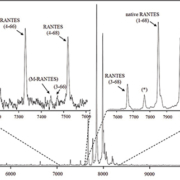
In the mass spectra, several RANTES proteoforms can be detected. As shown in Figure 1, most abundant are signals representing full-length, native RANTES (1-68) and met-RANTES, along with the N-terminally cleaved RANTES proteoforms (3-68) [MW=7,663.7; missing the ‘SP’ N-terminal dipeptide, product of dipeptidyl peptidase IV (DPP IV) enzyme cleavage] and (4-68) (MW=7,500.6; missing ‘SPY’ N-terminal tripeptide). RANTES proteoforms missing N-terminal tripeptide and C-terminal dipeptide, (4-66) (MW=7,282.3) completed the dominant signals (Figure 1, top right inlet). Additional RANTES proteoforms were identified, in lower abundance and frequency: (7-66) (MW=6993.1; missing six N-terminal and two C-terminal amino acids), (4-64) (MW=7040.1; missing three N-terminal and four C-terminal amino acids), (4-65) (MW=7153.2; missing three N- and three C-terminal amino acids) and (3-66) (MW=7445.5; missing two N- and two C-terminal amino acids). The signal labelled M-RANTES with MW=7413.5 has multiple N- and C-terminal truncation possibilities, and has not been specifically assigned. The assignation of these signals was done using the observed m/z values and the program Paws, and was in accordance with previously published qualitative results [16].
All identified RANTES proteoforms were quantified using an eight-point standard curve, in the range from 1.56 to 200 ng/mL. The standard curve was constructed from the ratio of the peak intensities of the RANTES standard and the met-RANTES IRS (y-axis) versus the RANTES standard concentration (x-axis). For the analytical samples, first, the RANTES/met-RANTES peak intensity ratios for each proteoform were determined and summed up. Using the generated standard curve equation, these ratios were used to determine the total RANTES concentration in the analysed plasma sample. Then, the concentration of the individual RANTES proteoforms was calculated based on their percentage of the total RANTES. The assay was validated through several standard procedures. The intra- and inter-assay precision experiments yielded coefficients of variation of <10%. Linearity and spiking-recovery experiments produced results between 92 and 112% (observed vs expected concentration). In a final test, the results of the RANTES MSIA were compared with those obtained with commercially available ELISA using Altman–Bland plot. A good correlation, with slight positive bias (11.3%) was obtained with the native RANTES [17].
The developed MSIA for RANTES proteoforms was applied to a cohort of 297 human plasma samples. The analyses were performed on an automated platform, which enabled for a high-throughput analysis of 96 samples in a single run. Among the samples, we were able to determine the concentration and frequency of 11 RANTES proteoforms (Figure 2). The total average concentration of RANTES was found to be 44.9 ng/ml (2.15–163 ng/mL). In majority of samples, the main proteoform was the full-length, native RANTES [c(RANTES(1-68))avg=37.4 ng/mL; 1.92–132 ng/mL], followed by RANTES (3-68), [c(RANTES(3-68))avg =6.64 ng/mL; 0.138–34.4 ng/mL]. The other truncated RANTES proteoforms were present in variable frequencies in the samples, albeit at much lower concentrations (<10% of the total RANTES). Figure 2 summarizes the distribution and frequency of all 11 RANTES proteoforms. Even though majority of RANTES proteoforms were detected in only a handful of samples and in low quantities, they should be given full attention. Cleaved proteoforms have the potential to be used as indicators of an enzymatic activity, and, in turn, of changes in the metabolic homeostasis [18]. The information that this MSIA provides puts a new perspective of RANTES quantitative analysis and can be a good starting point for looking at RANTES heterogeneity in clinical context.
Concluding remarks
The assay described above uses MALDI-TOF-MS to fully quantify RANTES proteoforms, and it is one of just a handful of such MALDI-based assays in existence today. The assay’s two-step approach is similar to that of well-established immunoassays, with the added benefit of MS detection as an enabling factor in differentiating the multiple proteoforms. The MALDI target is designed to accept the eluates from 96 tips at the same time, therefore making it high-throughput and time efficient (total time for RANTES assay is ~1 hour). The assay is performed on an automated platform, which limits the errors that can occur during assay execution. In review of previous and ongoing work, MSIA for RANTES performs well and introduces a new prospect and capacity for potential clinical applications in the field of biomarker discovery/rediscovery and diagnostics.
References
1. Strathmann FG, Hoofnagle AN. Am J Clin Pathol. 2011; 136: 609–616.
2. Agger SA, Marney LC, Hoofnagle AN. Clin Chem. 2010; 56: 1804–1813.
3. Kiernan UA, Phillips DA, Trenchevska et al. PLoS One 2011; 6: e17282.
4. Carr SA, Anderson L. Clin Chem. 2008; 54: 1749–1752.
5. Anderson NL, Anderson NG, Haines LR, et al. J Proteome Res. 2004; 3: 235–244.
6. Yocum AK, Chinnaiyan AM. Brief Funct Genomic Proteomic. 2009; 8: 145–157.
7. Nelson RW, Krone JR, Bieber AL, et al. Anal Chem. 1995; 67: 1153–1158.
8. Trenchevska O, Kamcheva E, Nedelkov D. Proteomics 2011; 11: 3633–3641.
9. Jin H, Zangar RC. Biomark Insights 2009; 4: 191–200.
10. Youn BS, Mantel C, Broxmeyer HE. Immunol Rev. 2000; 177: 150–174.
11. Lit LC, Wong CK, Tam LS, et al. Ann Rheum Dis. 2006; 65: 209–215.
12. Matter CM, Handschin C. Circulation 2007; 115: 946–948.
13. Azenshtein E, Luboshits G, Shina S, et al. Cancer Res. 2002; 62: 1093–1102.
14. Winnik S, Klingenberg R, Matter CM. Eur Heart J. 2011; 32: 393–395.
15. Kaburagi Y, Shimada Y, Nagaoka T, et al. Arch Dermatol Res. 2001; 293: 350–355.
16. Oran PE, Sherma ND, Borges CR, et al. Clin Chem. 2010; 56: 1432–1441.
17. Trenchevska O, Sherma ND, et al. J Proteomics 2014; 116C, 15–23.
18. Lim JK, Lu W, Hartley O, et al. J Leukoc Biol. 2006; 80: 1395–1404.
The authors
Olgica Trenchevska*1, Nisha D. Sherma1, Peter D. Reaven2, Randall W. Nelson1, Dobrin Nedelkov1
1Molecular Biomarkers, The Biodesign Institute at Arizona State University, Tempe, AZ, USA
2Phoenix Veterans Affairs Health Care System, Phoenix, AZ, USA
*Corresponding author
E-mail:
olgica.trenchevska@asu.edu
Point-of-care testing (POCT or POC testing) describes diagnostic tests which are performed at or physically close to a patient. This distinguishes POCT from traditional testing, which involves extracting specimens from a patient and transporting them to a laboratory for analysis. Settings for POC tests range from in-hospital bed sites and primary care offices to patient homes.
Over a half century of use
The POCT era is considered to have begun in 1962, after development of a system that measured blood glucose levels during cardiovascular surgery. The year 1977 saw the US launch of the first POC test for application wholly outside a hospital – the so-called ‘epf’ rapid pregnancy test.
POCT is increasingly used to diagnose and manage a range of diseases, from chronic conditions such as diabetes to acute coronary syndrome. One of the latest additions is a genetic test – CYP2C 19*2 allele for anti-platelet therapy.
Common POC tests includes “blood glucose testing, blood gas and electrolytes analysis, rapid coagulation testing, rapid cardiac markers diagnostics, drugs of abuse screening, urine strips testing, pregnancy testing, fecal occult blood analysis, food pathogens screening, hemoglobin diagnostics, infectious disease testing and cholesterol screening.” Nevertheless, just three tests – urinalysis by dipstick, blood glucose and urine pregnancy – are believed to account for the majority of POCT.
Turnaround time key to POCT appeal
The principal objective of POC testing is to reduce turnaround time (TAT) – a reference to the duration between a test and the obtaining of results which aid in making clinical decisions. In the past, such a process was unavoidable because of the sophistication and size of equipment required for the vast majority of medical diagnostic tests. However, technology developments have since made it possible to perform a growing number of tests outside of the laboratory.
Product miniaturization
Since the late 1980s, one of the key drivers of POCT has been product miniaturization with dedicated onboard integrated circuits. As described in a recent book on biomedical engineering, increasingly sophisticated microdevices have made it feasible to diagnose disease at point-of-care. These include “microfilters, microchannels, microarrays, micropumps, microvalves and microelectronics”, with their mechanical and electrical components “integrated onto chips to analyse and control biological objects at the microscale.” The authors list the key advantages offered by miniaturizing diagnostic tests as compared to centralized laboratory testing: portability, small size and low power consumption, simpler operation, smaller reagent volumes, faster analysis, parallel analysis, and functional integration of multiple devices.
Healthcare reforms drive POCT
Healthcare reforms have also driven POCT demand.
Spending controls and hospital mergers have led to shorter stays and faster patient turnaround. There have been growing demand for tests in outpatient clinics and patient homes. Test results have been needed quickly, not only for reasons of clinical urgency but also to ease patient waiting lists and reduce backlogs in emergency departments. Accompanying this has been the closure of several large central laboratories, which have further enhanced demand for POCT.
Making a case
The case for POCT has grown with time. In 2004, it was associated with a significant reduction in the time to treatment initiation and a shorter length of stay. More recently, a POCT cardiac marker screening stage at six UK hospitals led to a marked increase in the percentage of successful home discharges.
Such breakthroughs will increase as POCT use grows further, and as the tests become more sophisticated.
Early POC tests were based on the simple transfer of traditional methods from a central laboratory, accompanied by their downscaling to smaller platforms.
Subsequently, unique and innovative assays were designed specifically for POCT (such as the rapid streptococcal antigen test). Wide arrays of POCT-specific analytic methods have also been developed, ranging from simple (such as pH paper for assessing amniotic fluid) to the ultra-sophisticated (for example, thromboelastogram for intraoperative coagulation assessment).
Contemporary POCT systems are usually based on test kits and portable, often handheld, instruments. Many tests are realized as easy-to-use membrane-based trips, often enclosed by a plastic cassette. This requires only a single drop of whole blood, urine or saliva, and they can be performed and interpreted by any general physician within minutes.
Hospital emergency departments
Given its time-sensitive relevance, one of the fastest growing users of POCT have been hospital emergency departments (EDs).
In 2008, a study in ‘Academic Emergency Medicine’ simulated the impact of reduced turnaround times and established grounds for a “compelling improvement in ED efficiency.” Though its authors concluded that specific outcomes such as the length of stay and throughput in the emergency department warranted further investigation, they categorically recommended POCTs as a means to improve turnaround time.
Over recent years, favourable perspectives on POC tests in the ED have strengthened. At the end of last year, a study in ‘Critical Care’ found POCT increased the number of patients discharged in a timely manner, expedited triage of urgent but non-emergency patients, and decrease delays to treatment initiation. The study quantitatively assessed several conditions such as acute coronary syndrome, venous thromboembolic disease, severe sepsis and stroke, and concluded that POCT, when used effectively, “may alleviate the negative impacts of overcrowding on the safety, effectiveness, and person-centeredness of care in the ED.”
Other POCT users include ICUs as well as endocrinology, cardiology, gastroenterology and hematology.
Primary care remains principal user
The bulk of POC tests are however conducted by primary care physicians.
In 2014, the ‘British Medical Journal’ published the findings of the first-ever survey of POCT use by primary care physicians in five countries (Australia, Belgium, the Netherlands, the UK and the USA). The study found that blood glucose, urine pregnancy and urine leukocytes or nitrite were the most frequently used POC tests. Overall, more respondents in the UK and the USA reported using POC tests than respondents in the other countries. The widest gap in use of POC test was for fecal occult blood, used by 83% of US doctors against only 2–18% of primary care clinicians in the other countries.
One of the key findings of the ‘British Medical Journal’ study, however, was that there was an unmet need for new POC tests. Included here were tests for D-dimer, troponin, chlamydia, gonorrhea, B-type natriuretic peptide, CRP, glycated hemoglobin, white cell count and hemoglobin, which were desired by more than half of respondents across all the five countries.
Fast growing market
Over the past two-and-a-half decades, the availability and use of POCT has steadily increased. By 2012, nearly 100 companies worldwide were developing, manufacturing or marketing POC tests. One study, cited by the National Institutes of Health in the US, places POCT sales in 2011 at about $15 billion (€13.5 billiion). Of this figure, the US accounted for a share of 55%, Europe for 30% and Asia for 12%. The market is projected to show compound annual growth of 4% to reach $18 billion (€16.2 billion) by 2016.
Further growth in the use of POCT is expected to be driven by increases in accuracy, reliability and convenience. Alongside, one of the biggest catalysts for increased POCT use may consist of quality standards.
The quality challenge
Issues about POCT quality continue to vex experts. Variability in the interpretation of POC test results is a widespread concern, given differences in the education and experience of staff who conduct the tests. In addition, POCT results may also not be comparable across sites (e.g. when patients travel) and differences in specimen types (serum, plasma or whole blood) can impact on results – as compared to those from a traditional central laboratory.
In a laboratory setting, analytical quality is usually assessed by QC (quality control) and QA (quality assurance) procedures. Their aim is “to monitor the stability of the analytical measurement system and to alert the operator to a change in stability”… “that may lead to a medically important error.” While these processes serve a laboratory well, it is unclear whether these processes are relevant, transferable and practical for monitoring quality on POCT devices.
Regulators and POCT in the US and the EU
Future developments are expected to be driven by regulatory bodies.
In the US, CLIA88 (Clinical Laboratory Improvement Amendments of 1988) provided a major impetus for growth in POCT. The rules, published in 1992, expanded the definition of ‘laboratory’ to include any site where a clinical laboratory test occurred (including a patient’s bedside or clinic) and specified quality standards for personnel, patient test management and quality.
One of CLIA88’s biggest contributions to POCT growth was to define tests by complexity (waived, moderate complexity and high complexity control), with minimal quality assurance for the waived category.
CLIA88 has been followed by US federal and state regulations, along with accreditation standards developed by the College of American Pathologists and The Joint Commission. These have established POCT performance guidelines and provided strong incentives to ensure the quality of testing.
In Europe, POCT devices are regulated under the 1998 European Directive 98/79/EC on in vitro diagnostic medical devices, although the term itself is not specifically mentioned. There have since been several amendments, most recently in 2011 (2011/100/EU), as well as standards based on the Directive’s framework.
However, at the European level, specific coverage of POCT is referred by international standard ISO 22870:2006, used in conjunction with ISO 15189 which covers competence and quality in medical laboratories. It is important to note that patient self-testing in a home or community setting is not covered by ISO standards.
The role of ICT
The role of ICT in driving the growth of POCT is also likely to become crucial. In the late 1990s, there were concerns that POCT implementation, especially in the real-time critical care context, was accompanied by little understanding of its information technology requirements.
However, the situation has since changed dramatically, especially as ICT is seen as the only appropriate interface between POC test results and computerized patient records – seen as the means to restructure clinical care pathways.
ICT is also accepted as the best means to standardize care protocols. In 2012, a study found that the impact of point-of-care panel assessment on successful discharge and costs varied markedly from one hospital to another and that outcomes depended on local protocols, staff practices and available facilities. In effect, the study highlighted the importance of optimizing clinical pathways to derive maximum benefit from the reduced turnaround times provided by POCT.

When founding the company GONOTEC GmbH in 1979, electronics engineer Harald Göritz and chemist Klaus Noack could not possibly imagine that their target to develop, produce and market analytical measuring instruments for medical and chemical application would be as successful as it turned out to be. Both founders of the company could already look back to decades of experience in this field.
It all started with a cryoscopic osmometer for clinical application: the OSMOMAT 030. At the first exhibitions he visited, Klaus Noack was surprised by the high level of interest generated by the instrument. There was no other way than to expand production to cope with the increasing demand for this osmometer, which offered a complete ease of handling, previously unattained, resulting in a growing number of sales.
Inspired by this success, a new osmometer was developed by Klaus Noack to complete the osmometer line for medical application: the colloid osmometer OSMOMAT 050. Even though the market for this instrument, basically used in intensive care units, was not as big as for the OSMOMAT 030, the product also contributed to the further success of GONOTEC GmbH.
In the middle of the 80’s, development started on a new range of instruments, namely the chemical osmometers. The aim was the development of instruments for the determination of molar masses based on osmotic parameter for chemical application that also offer easy handling for the user.
The three osmometers, vapor pressure osmometer OSMOMAT 070, membrane osmometer OSMOMAT 090 and cryoscopic osmometer OSMOMAT 010 complement one another due to their different measuring methods in the determination of the range of molar masses up to 2,000,000 Dalton.
In 2001 the general management of GONOTEC was taken over by Jan Celinsek, who worked already with GONOTEC since 1991.
In 2003 a new model in the osmometer family was launched into the market: the OSMOMAT auto, which is also characterized by extreme reliability and easy handling, thus fitting perfectly into the already well known GONOTEC osmometer line.
In 2009 GONOTEC moved to new premises with lots of space for new ideas! In the same year, the chloridmeter CM20 was launched, followed in 2013 by the next generation of osmometers: the OSMOMAT 3000 and the OSMOMAT 3000 basic, both replacing the well known OSMOMAT 030.
To this day, GONOTEC is no large, anonymous concern but still a medium-sized, private company, owned by Klaus Noack, the founder. However, we became a global player with customers in more than 60 countries.
One of the most valuable resources GONOTEC always had was its permanent staff. Once people start working for GONOTEC they stay with the company as they are proud of their work. The same applies to the numerous number of dealers all over the world. The cooperation between the agents and GONOTEC is like in a family; constant trainings at the company headquarters improve this special relationship between agent and manufacturer. GONOTEC products do deserve the description “Made in Germany”, as the whole production is in one location. It is easy for external persons visiting the company to see an osmometer being manufactured from the very beginning to its finishing and perfect functioning.
Since GONOTEC was able to export the company’s philosophy by means of the highest quality standards and competence as well as constant assistance to customers and agents, it is looking optimistically into the future. Our company’s philosophy is a promise to all our customers and potential customers.

June 2026

Prins Hendrikstraat 1
5611HH Eindhoven
The Netherlands
info@clinlabint.com
PanGlobal Media is not responsible for any error or omission that might occur in the electronic display of product or company data.